Showing posts with label Bible artist. Show all posts

Saturday, February 28, 2009

Painting the Hebrew Bible: Words and images.

I would like to take this opportunity to introduce you to a new visitor to the Bible illustration blog, whose recent comments on the blog I know many of you have found incredibly helpful. Nahum HaLevi, (who is also a Levite), is a Jewish Bible artist based in the U.S. His paintings can be found at Nahumhalevi.com. Each painting on Nahum's website is accompanied by a highly detailed description which, apart from being a fascinating read, reveal Nahum's immense knowledge of the Torah. I asked Nahum if he would consider writing a short post for the B.I.B describing his Bible Art. He kindly agreed.


Painting the Hebrew Bible: Words and images, by Nahum HaLevi. 
The thrust and focus of my paintings is an attempt to grasp the transcendent meaning of the Hebrew Bible, and by extension to use art as a tool to try to understand the underlying nature, structure and essence of the universe, in other words to apprehend God. As a template for this process  I attempt to visually express the biblical narrative by deriving multiple images from multiple translations of the original Modern Hebrew text, and at times retranslate the words back into ancient Hebrew and further back into proto-Sinaitic pictographic Hebrew.
  Biblical Hebrew contains many words with multiple meanings, a testament to its very early and ancient origins. The meanings of some Hebrew words can be radically changed by a mere alteration of pronunciation, or textual context, or even by a single letter substitution. These linguistic elements have led to a wealth of literary interpretations.
 Many of my paintings combine the multiplicity of meanings of the Hebrew biblical text with the multiplicity of visual images derived from these different literary interpretations of scripture thereby resulting in combined visual-literary stories that are not possible by isolated pure literary or visual analysis.
  For some paintings I fuse images and words from disparate scriptures thereby creating fusion imagery of disparate biblical characters and concepts in different historical space-time coordinates into one holistic story. By retaining fragments of the different stories, each individual story is told, and a new creative story is told for the first time, providing multiple layers of meaning to the original stories.
  In some paintings , I use the principle of taking stories of individual characters from sequential chronological periods of their lives and jumbling them up into one narrative as though each story is a single point in the space-time continuum, and lives not only in the past or future, but in the never ending present.
 
One example of this is in the painting "Moses : Rock 'N Rage".
In this painting I have fused the young Moses who hits and kills the Egyptian taskmaster drawing out blood, with the older Moses who hits the rock in the desert, drawing out water quenching the Israelite's thirst. Also visually fused in this painting , are the Egyptian taskmaster and the rock who spew out blood and water as a result of being hit by Moses. The inspiration for this imagery comes from the common Hebrew word used in both stories for hitting- "Vayach"- "and he hit", either the Egyptian or the stone.
 The visualized simultaneity of two separate historical events combined with the simultaneous sequential chronological unfolding of both separate events, confuses our natural understanding and perception of linear time, providing us with a more accurate perception of the malleable bending of the space-time continuum, and thus fills us with an other worldly ethereal transcendental feeling.
 In some paintings I attempt to create a cinematic sensation of time moving both forwards and backwards on a two dimensional canvas by having individuals moving multiple arms and legs in different sequential geometric and spatial planes. I have used this technique in "Moses : Rock 'N Rage", and even more so in "The School of Shamgar".
   In a similar vane in the painting "The Amramovitz Family: Teamwork", I portray the infant Moses with a beard, fusing two of Moses' time coordinates; that of his infancy with that of his adulthood visualizing the simultaneous separate existences of these images within the space-time continuum, as well a providing a sensation of time rapidly moving forward or backwards from infancy to adulthood, depending on one's perspective. Again this confuses our perception of ordinary space-time and transports us into another realm of thought which transcends the ordinary laws of physics as we perceive them.

 In my paintings I also like to convey a sensation of synesthesis. Synesthesis is a neurological condition where certain individuals crisscross and confuse different senses, for example, some people can taste or hear colors. Certain people can see sounds. This is what is conveyed in the Bible , at Mount Sinai, when the Ten Commandments were given, and God descended on the mountain, that all Israel saw the sounds of the shofars (trumpets) and the sounds of thunder. I have conveyed this in my painting  "Shavuot" by drawing musical notes in the background. Similarly in many of my paintings I hope they are appreciated by utilizing sensory modalities other than sight, and I hope that you not only see the paintings, but hear their conversations, and the music they are playing, and hence I hope you fuse sight and sound, that you see and hear illuminated symphonies, and that you are momentarily transported and enjoy a separate reality.
By providing and fusing multiple scriptural word definitions and multiple images derived from them, in many paintings you might see simultaneous multiple image possibilities, and you might simultaneously sense that you are in the past, present or future, or all three, You might sense that you are at location X, or Y, or simultaneously feel that you are at both locations. When you read a word or several words and sentences, you might simultaneously understand multiple definitions and explanations. If you do all that, you might appreciate a greater totality of the universe, or at the very least will understand the limitation of our human brains when viewing things statically.
   I personally view every two-dimensional biblical canvas as a small bird's eye view of the vast space-time continuum. Different splashes of paint and letters all represent different points scattered in space and time, existing separately and yet simultaneously, all splayed out in a microcosm before our frail visual fields allowing us to grasp past, present and future in simultaneity, as they twinkle, coexist and meld into one unified coherent whole giving us a multifaceted perception of infinitely changing realities- dare we say a fragmentary glimpse of God.

Thursday, September 18, 2008

Guest Bible Artist interview #5

Annie Vallotton
Annie Vallotton.
You may not be familiar with the name 'Annie Vallotton', but you will almost certainly have seen her pictures! Which is not surprising as a press release I came across recently from publisher HarperCollins claims that Ms Vallotton is the "Best selling artist of all time!" What you might find surprising though is that this 'best selling artist of all time' is famous for her Bible pictures! Swiss born Annie Vallotton, who now lives in Paris, provided the line illustrations for the 'Good News Bible' back in the 60's. According to the press release from HarperCollins, Ms Vallotton's picture sales are in excess of 70 billion-!!
last month, the 'American Church in Paris' dedicated a new library to Ms Vallotton called the 'Annie Vallotton lending library' and Ms Vallotton attended the service. (see picture above courtesy of Mike Norris).
Our 'Contact in Paris' Paula Taquet-Woolfolk, who attends the ACP, very kindly offered to interview Ms Vallotton on behalf of the Bible illustration blog, and conducted the interview in both French and English.

Before we go into the interview I would like to share with you a little bit about Annie Vallotton that Paula discovered while having lunch with her.
Annie, fresh from her art studies, didn't launch herself into a career, but worked in the refugee camps during the second World War painting frescos on the walls making them more welcoming to the refugees who included families from Poland, Estonia, and the Baltic region. Annie worked through the night on the murals and slept during the day!
It was while working in a refugee centre in Toulouse that AV met her lifelong friend Jeanne Bulté. Jeanne Bulté was a social worker, who was assigned to work in the same refugee center in Toulouse. During the war, both Annie and Jeanne worked in the Resistance. Annie's Swiss nationality helped her when she transported mail back and forth. While working in the camps Annie and Jeanne met Bertie Albrecht, (the leader of the Résistantes - the female part of the Resistance). Bertie told Annie that Annie's grandfather, Paul Vallotton, had baptised her many years before!
Later, Annie saw Bertie Albrecht on one of the streets of Paris, heavily disguised. Bertie told Annie that she had acted insane while she was in prison so that she could get out. Bertie continued to work in the Resistance until she was killed by the Germans.
Annie comes from a very talented family. Her father, Benjamin Vallotton, was a well known writer and wrote 55 books. Her father's cousin was the well known painter Félix Vallotton. Annie's brother Pierre followed in the footsteps on his Grandfather and became a minister. He also built by hand many magnificent church organs! Annie herself is also very musical and plays the violin.

The Interview:
How did you come to illustrate the Good News Bible, and how many illustrations did you complete for it?
In the early 60s, a man from the American Bible Society, American Eugene Nida (currently living in Brussels), contacted me from Germany to ask me if I could come to Stuttgart where he had ten minutes only during which he wanted to see me. Was I willing? Yes I was willing. I met him at the airport and he had one of my very first books with him. He wanted me to make illustrations for the Good News Bible (GNB) an edition for children, and he wanted the same kinds of illustrations that I had done in this book. He said "I want very much to have Your illustrations because your illustrations are very simple, and we love them!"
He said "Are you ready to do this?" I replied "Yes, I am quite ready!" I was very excited. Then I started doing the Bible illustrations and I've been doing them all of my life! (AV laughs). I believe I did around 510 drawings!

All in Black and white?
Yes, all in black and white unfortunately. I have recently received a new edition published by the Korean Bible Society with my illustrations in color. I was very surprised to see it in colour! I believe this is the first edition of the GNB with all illustrations in color. I asked the American Bible Society to make one, they agreed, but I've been waiting for three years!

Can you remember how long it took you to illustrate the Good News Bible?
I can't remember. It took me a long long time I must say, I didn't want to have illustrations with many lines. My desire was to have just the main lines. This is why I did some of the drawings 80-90 times before I achieved the one I wanted. I wanted to simplify them the most I could. I wanted to get to the truth...the most important thing!

Did you have an interest in the Bible before you were asked to illustrate the GNB?
Yes, I became a Christian at one month of age, (AV laughs), so I've always been interested in the Bible. My younger brother, Pierre Vallotton, is a minister, (now retired). He was at the Reformed Church of Saint-Dié, in the Vosges (Église Réformée de Saint-Dié). He built the organ there and asked me to design six stained-glass windows depicting the Creation. It was a fascinating job to do! (see windows below). Also on one of the inside walls of the Église Réformée de Saint-Dié, there's a large painting by the French painter and Pastor Henri Lindegaard (1925- 1996).


Can you remember having any difficulty depicting any Biblical characters, or a particular Bible story?
No particular difficulties - I wanted to illustrate everything, even if it was very difficult. My desire made it easy. I wanted to reach the youngsters.

Your style has a timelessness about it due to its simplicity, and yet at the same time, you manage to get so much expression 
into each picture. Did you illustrate the GNB in your own style, or did you simplify your own style?

Yes, yes. Exactly so! I wanted to be as simple as I could, especially for the youngsters, but also for the adults too!

Many people have commented that your pictures never distract from the text, and never try to interpret the story. Was his difficult to accomplish?
I did not find this difficult to accomplish, because I tried to find total simplicity.

Did you find yourself having to do much research into Bible clothing, buildings, customs etc?
I had no need to research clothing or buildings, you see, I wanted drawings that were 'out of time'.


What did you use to illustrate the pictures with? Also, did you add colour to any of the pictures yourself?
I used a pencil to do the roughs and a pen to ink them. I never added color, someone else did that.

Do you still do any Bible illustrations?
Yes! What I am doing a lot now is speaking to children in many different churches. On 21st September I will be speaking at 'Temple du Foyer de l'Âme'. I am going to this church to speak to the children about the Lord, and to draw for the children. I hope to have a lot of children there. I will teach them a song also! (AV sings a little chorus for Paula, she's very musical!)

Have you illustrated any other Bible related books?
Yes, several. 'Priority: Jesus' life in 60 drawings', 'From the Apple to the Moon', 'The Mighty One and Sam', 'Who Are You Jesus', 'The Man who said No: Story of Jonah' also 'Blessed Are the Peacemakers'. I also worked with author Claire-Lise de Benoit. Our books were published in Africa in many different dialects. Over one hundred I believe!

Bible artists rarely get recognized for their work, but this month saw the opening of a library in Paris dedicated to you! (At the American Church in Paris)
Was this a big surprise to you?
 
Nothing coming from the Americans surprises me! (AV laughs). I was very, very touched, I love the American people.

I read on the internet recently that, according to the publisher Harper Collins, you are the 'Best selling Artist of all time'. Do you have any comments on that?
(Ms Vallotton laughs) Laughter is the king, and saves one's life! You especially need humor! Too many people read the Bible with a severe face! I say no, the Bible is not that! The Bible is life, and it is wonderful! (Paula agrees).


The photo above was taken in the church which Annie attends and shows her speaking to the children with the aid of an overhead projector. Annie Vallotton clearly loves children, and has dedicated her life to presenting the Bible message in the clearest possible way to them. It's fitting that the illustrator of the 'Good News' Bible is still active presenting the Good News in person! I would like to close with a quote from another interview with Anne Vallotton conducted by Annie Biroleau-Lemagny. (kindly translated by Paula Taquet-Woolfolk).
"She (Annie) attributes the success (of her pictures) to the simplicity, and the absence of ethnocentrism which permits each person to project his own face and his own culture onto her graphic suggestions".

Thank you so much again Ms Vallotton for agreeing to the interview. A big thank you also to Paula Taquet-Woolfolk for conducting the interview, and Mike Norris, also from the American Church in Paris, for providing the photo of the dedication service.
As Ms Vallotton has no internet access, I will send a selection of the comments that readers leave on this post for her to see.

Update: December 2009
Just received a Christmas card from Annie in which she writes:
"I love very much all what is said in the comments on the Bible illustration blog...... All the comments go in my heart because they look so sincere."
Annie goes on to say that she wants to write a reply to each comment which she is doing slowly. I will add these comments as soon as I receive them.

Black and white photo © Eglise Réformée de l'Oratoire du Louvre 2008.
Annie Vallotton illustrations © Bible society 2008


Related posts:
Interview with Jeff Anderson
Interview with Keith Neely
Interview with Diana Shimon
Interview with Dr Leen Ritmeyer

Friday, August 08, 2008

Elsie Anna Wood

Many thanks to Prof Sandy Brewer for writing our fourth 'Guest Article' for the Bible illustration blog. Click on the pictures below for a larger image.

Elsie Anna Wood (1887 – 1978)

Elsie Anna Wood was born into a Baptist family who were all active in the local chapel in Crouch End, North London. Like so many other women illustrators – e.g. Cicely Mary Barker, Margaret Tarrant and Eileen Soper - she was fortunate in having an artistically talented father to encourage her precocious talents. Charles Wood worked in the art department of a London publishing firm, and, from a very early age, she was encouraged to draw and paint , and introduced to the tools, materials and skills required of a commercial artist. Elsie attended the Hornsey School of Art from the age of seventeen but was prevented from advancing to the Academy schools of art by a change in her family’s circumstances that necessitated her seeking paid employment. She produced illustrations for various publications working only in pencil or ink and taking up the challenge of full colour illustrations for books in her early twenties. Up to this point Elsie Anna Wood’s life might have taken the trajectory of contemporaries such as Margaret Tarrant who lived and worked in the Engish Home Counties, but in 1919 she successfully applied for a job with the Nile Mission Press working under the auspices of Constance Padwick in Cairo. Her role was to provide the accompanying illustrations for the children’s literature produced by the Press. The post was for six months and enabled Elsie to travel through Palestine as well as Egypt.

After returning to the UK she unsuccessfully applied to serve as a missionary overseas, but five years after leaving Cairo she was asked to return to Egypt to work for the Society for the Propagation of Christian Knowledge (SPCK). It is the work she produced for the SPCK that made the name of Elsie Anna Wood synonymous with Bible illustration all around the world. Many artists before her had travelled to the Holy Land - e.g. Tissot, Hole, and Copping – to observe at first hand the people and places of the Bible, but none of them had moved beyond the experience of a tourist to live and work among the people as Elsie Anna Wood did. As a result of her close observation and drawing from Palestinian models, she has, uniquely, shown us a Christ from Palestine which is in stark contrast to the conventional blonde European portrayal of Jesus adopted by most twentieth century Bible illustrators. But her bible illustrations were innovative in other ways too.

In her illustration of the infant Jesus (left) she shows us a self-confident child who looks out – confrontationally - at the audience.
In the background detail of picture 1, (above right) she reminds us that Jesus spent his early years in Egypt. Dr Brewer pointed out to me that the boats in the background of picture one (above) are 'Dhows' which were traditional Arab sailing vessels. GK

In picture 4, (bottom centre), the depiction of Jesus as healer, she conveys the light and shade and the movement of the crowd in the confined space of a Palestinian town. Finally, in what is my favourite of all of her illustrations of Jesus blessing the children (below right) she makes the disciples sympathetic characters and does away with the forbidding effect they might have on young viewers.
It is an interesting composition which adopts as its point of view that of a child and the effect produced is one of looking upwards to Jesus. There is also a strong impression created of a crowd pressing in on Christ and, as in other versions of the scene, there is a tree arching over the top of the picture, but this one is laden with pomegranates – a fruit with particular symbolic significance for Christians. As we look longer into the picture, other small figures become visible, one of whom is holding onto Jesus’ robe, smiling shyly while looking out at the viewer. Jesus is shown holding one small child, as is the convention in the scene, but what is different here is that he is reaching out to touch the head of a baby, which is being held by one of the disciples. This man is looking down at the baby with what appears to be puzzlement and Christ is depicted as looking at him and smiling. At the top left of the picture is another disciple, again with an infant in his arms. This is not a scene of rejection but of joyful happiness and among its many innovations is that Jesus is shown with his hair cut short and his beard clipped, as are the disciples who look like the young men they actually were, rather than the elderly patriarchs of convention.

This picture is carefully composed to take account of the predispositions of the very young child. For example, it is notable that in many hymns for children the writers never seem to tire of stressing the smallness of children yet this picture offers a way for the young viewer to overcome the limitations of its small stature in relation to that of adults. The dynamic of the composition is created by the line of sight which starts with the mother in the bottom left hand corner, moves up past the two small children, on to Jesus’ face, and ends with the smiling face of a little girl sitting on her mother’s shoulders. It is an adult who is in the lowest position in the picture and a child in the highest.

The format of Sunday school kindergarten lesson was the telling of an illustrated story, followed by activities linked to what had been heard. Within that context, this picture offers a multitude of opportunities for imaginative engagement with what is being depicted. Because some of the detail is half-hidden in the picture, it offers the chance of a game of seeking out visual information – an activity that requires the involvement of the teacher. The attention to detail of dress and ornamentation is again typical of the artist, but also indicative of the level of authenticity that publishers and educationalists expected. Learning about the dress, the customs, and geography of the Holy Land was all part of the process of making Christ real for children. Having lived and worked in the Holy Land, Wood was familiar with the inhabitants and was able to produce depictions of Jesus, his disciples and the people around him as clearly belonging to Palestine, whilst at the same time avoiding the orientalist excesses of other illustrators.

Elsie Anna Wood produced over 100 bible illustrations for the SPCK, which were published in various formats as books, postcards, attendance stamps, as well as large posters for the Sunday school classroom. The pictures were produced for educational purposes and to that end seem to transcend the limitations of two dimensions by compositional devices which draw the viewer further into the picture the longer one looks at it.

Elsie Anna Wood was a remarkable woman making her own living in the UK and the Holy Land at a time when society deemed a woman’s place to be in the home. She was not only a brilliant artist, she was also more astute in her business dealings than other Bible illustrators. When Harold Copping produced his sixty-four illustrations for the Religious Tract Society he was given a fixed sum for each completed picture with no royalties for the millions of reproductions which followed from his work. In addition, he was legally prohibited by the society from producing Bible illustrations for any other publisher. Elsie Anna wood on the other hand, had the foresight to opt for a contract, which gave her royalties on reproductions of her work and not just a one-off payment for each picture. This gave her a steady, if modest income which supported her through her long and productive life. Elsie Anna Wood died in a Norwich nursing home in 1978 but her work lives on, albeit with substantially less public recognition than it deserves. These short notes offer just a brief overview of the artist and a longer article will surface in the near future.
© Dr Sandy Brewer 2008

Related posts:
More 'Elsie Anna Wood' Bible Art
A Gift Returned with Love.

Wednesday, October 03, 2007

Happy Birthday B.I.B!


Today is the official 1st birthday of the 'Bible illustration blog'.
A total of 12,876 visitors have read 37,925 articles in the last 12 months!

I would like to give a big thanks to all the regular readers & contributors, and look forward, God willing, to posting more new articles, interviews and reviews over the coming months.

Many thanks & best wishes to all!
Graham

Update:1st Nov 2007
Readership of the blog continues to grow steadily. In the month of October just gone, we had 2,219 visitors who viewed 6,720 pages! That's roughly 550 visitors a week, and 699 more visitors than last month!

Tuesday, June 19, 2007

My favorite Bible artists #4

Cicely Mary Barker 1895-1973

Cicely Mary Barker is better known for her 'Flower Fairies', but she also illustrated some wonderful Bible pictures. She obviously loved to draw children and flowers, and both found their way into her Bible pictures.

It is well known that her sister Dorothy set up her own school to help earn money for the family, and Cicely used the children as models to draw from, in both her flower fairy, and Bible pictures.

I love her delicate style, she manages to capture the innocence and wonder in the children's faces as they watched the Saviour. She was also another Bible artist who, like Frank Hampson, thrived on detail. The plants and flowers that she illustrated were observed with complete botanical accuracy. Her figure work was also anatomically perfect!
It wasn't only her color work that was impressive, her pen & ink work was superb also.

Cicely was a delicate child, who suffered from epilepsy, and because of this was educated at her Croydon home. After the early death of her father, she helped to earn money for the family by selling her pictures and poetry. In her later years she was described as a humble, modest lady. She had a strong Christian faith, and was an active member of St Andrews church in Croydon.

More about Cicely Mary Barker here.

Favorite Bible Artist #1 Frank Hampson
Favorite Bible Artist #2 Nestor Redondo
Favorite Bible Artist #3 Clive Uptton

Tuesday, June 05, 2007

My favorite Bible artists #3

Clive Uptton 1911-2006
Clive Uptton was a Wartime political cartoonist for the Daily Sketch between 1940-1942. He was a left handed artist like myself, but wrote with his right hand!
You can actually tell he was left handed from his Bible pictures! (left handed artists draw the shine in peoples eyes on the left hand side! Right handed artists draw it on the right.)
As well as his pen and ink drawings he liked to work in watercolors, oils and acrylics, Following the war he became an internationally successful illustrator, poster artist and painter, painting both landscapes and portraits. In 1930 Clive Uptton added an extra 't' to his name to avoid confusion with another illustrator of the time named Upton.

In the late 1960's Clive Uptton was commissioned to produce 121 full-color Bible illustrations for 'Egermeier's Bible Story Book. I first came across Upttons Bible pictures in the Ladybird Bible stories series, (606A). In my humble opinion he was the best artist in this series. I'm not sure if these pictures were reprints from the 'Egermeier's Bible as I don't have one to compare them with.
It's easy to spot a Bible illustration by Clive Uptton, as all his characters seem to have big brown eyes! I particularly like the facial expressions he manages to capture.

Uptton died shortly before his 95th birthday.

Favorite Bible Artist #1 Frank Hampson
Favorite Bible Artist #2 Nestor Redondo
Favorite Bible Artist #4 Cicely Mary Barker

Sunday, October 08, 2006

My favorite Bible artists #1


Frank Hampson 1918-1985
Frank Hampson was better known for his work on 'Dan Dare' a strip that ran in the 'Eagle', a British comic for boys in the 50's and 60's. 'The Road of Courage' was a lesser known strip in the same comic that was a retelling of the New Testament story.
Many thanks to Dragons Dream who had the foresight to reprint this strip in book form in 1981. A word of warning. I would not recommend this book for its theology!

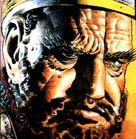
The artwork, as you can see from the sample of 'Herod' was outstanding. His draftsmanship and attention to detail is unsurpassed even today.
I believe he worked from photographic references that were dramatically lit by the photographer. Hampson also traveled to the Holy land to gather picture references for this book.

I'm not sure if Hampson used a brush or nib to ink in his line-work. If anyone knows, please add a post!
My only criticism is the way Hampson depicted the Lord Jesus. He looks like Dan Dare with a blond wig on! But other than that, it's some of the best artwork I've seen! Hampsons excellent choice of models, also shows his flair for casting!
More about Frank Hampson here: Frank Hampson.

Favorite Bible Artist #2 Nestor Redondo
Favorite Bible Artist #3 Clive Uptton
Favorite Bible Artist #4 Cicely Mary Barker