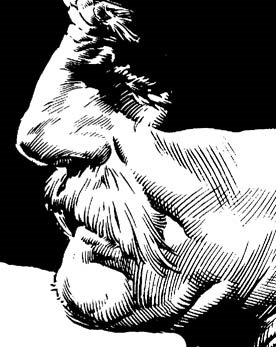
Annie Vallotton, illustrator of the iconic images in American Bible Society’s Good News Bible, died in France on December 28, 2013 at the age of 98. The publisher HarperCollins has identified Vallotton as the best-selling artist of all time, thanks largely to the success of the Good News Bible, of which more than 225 million copies have been distributed since its release in 1966.
Annie Vallotton, who was born in Lausanne, Switzerland, dedicated her life to finding ways to share the Bible’s message in a clear, simple way. In addition to the Good News Bible, Vallotton illustrated other Christian books, including Who Are You Jesus? and From the Apple to the Moon.
From the American Bible Societies website
We sent Annie a christmas card which included all of the recent comments that readers have left on the 'Annie Vallotton interview' post. Annie replied via her sister-in-law Heidi, (as Annie was getting weak). They sent us a lovely card and letter on the 17th December - she passed away just over a week later. Our condolences go to the Vallotton family.
There are some exciting things about to happen within the next month or so regarding Annie's life and work which I am not at liberty to mention just yet. As soon as I get the 'thumbs up' from HarperCollins I will tell you all about it!
If you would like to leave a comment/tribute on this post, I will gladly send them on to the family. If you haven't read the full interview with Annie yet, Click here. She was a very special lady.
Annie Vallotton
21 February 1915 - 28 December 2013.
At home with her Lord.
A Blog for those who illustrate Bible pictures and those who use them! A place to discuss all aspects of Bible illustration.
Showing posts with label Bible artists. Show all posts
Wednesday, February 05, 2014
Sunday, November 14, 2010
Guest Bible Artist Interview #7
Tim Shirey
We have looked in the past at some of the work of missionary artists such as Elsie Anna Wood and Harold Copping. The job of a missionary artist, very simply put, is to produce illustrations as an aid for those whose task it is to present God - and the message of the Bible to an unbelieving world. It's been my privilege recently to interview one of todays missionary artists Tim Shirey. Tim is a regular contributor on the Bible illustration blog and works for Child Evangelism Fellowship (CEF) at their European Regional Office in kilchzimmer Switzerland. The interview is slightly longer than our previous interviews but I'm sure that you will find in fascinating. Our hope is that this interview will inspire young people to become the missionary artists of tomorrow!
Tim, how long have you worked for CEF? Since 1985 and I was in the CEF European Regional office since 1986.
I often get asked the question "Are there many opportunities for artists in the mission field?" How would you answer this, and how did you become a missionary artist?
In 1979 (while in high school) the Lord laid it upon my heart for missions and more specifically the region of Russia and Central Asia. I wanted to use my art in some way – just not sure how. The Lord answered that prayer by sending me to Switzerland where, at the time, most of our literature was going into the Soviet Union. I share this because often the Lord answers our prayers and brings it about in the most unexpected ways!
In high school I spent several summers teaching children in backyard Bible clubs (CEF) using visualized Bible lessons and missionary stories. All the songs and memory verses were also visualized to help teach the truths and supplement the text. I saw the impact visuals had in effectively teaching God's Word. The pictures help hold the children's attention and besides visualizing the Bible story itself there were additional pictures to help teach spiritual truths. In some parts of the world visuals play an even greater role in communicating the Truths of God's Word to children and adults. I grew up in a printing family and now I'm thrilled to have a small part in sending out millions of "missionaries in print".
Over the years I've met missionaries where their skill and training in art played a central role in their ministry but I also met those who have used their art training to complement another area of ministry. For example, I met an art student who went on to be a youth pastor and used his art when developing teaching materials. This opens the door wide open for ways to use your art on the mission field.
CEF is working in more than 178 countries and we see many opportunities for illustrators not only in literature but also with the wide open field of multimedia and the Internet where we are reaching children not possible through literature alone. I could fill several pages listing projects we are unable to take on because we simply don't have the artists. Having artists that are familiar with a particular culture is very helpful because sometimes we customize the illustrations to meet the cultural differences of a particular country or region – for a child in Finland or Central Asia to hold a Gospel booklet and know that this is for me. The majority of illustration work is done at the CEF International office, with the regional offices supplementing with material that meets specific cultural needs in their region.
For example, CEF Int'l produces a booklet called "Do You Wonder Why?" which is distributed in areas of the world immediately after a natural disaster or traumatic event. I customized some of the illustrations for Poland [see image] so it would better relate to the plane crash earlier this year involving the President, his wife and other officials. 40,000 copies of the evangelistic booklet were distributed in two days at memorial services around the country with an overwhelming response. Another 40,000 were immediately printed and distributed. This is an example of having artwork that relates to the culture and specific needs – something we are able to do at the regional level.
Do you only work on Bible stories or are you asked to illustrate other subjects too?
A single CEF Bible lesson will usually consist of 6-8 full colour illustrations. Visuals (in Europe) are reproduced at 24x34cm with the lesson text printed separately into the different languages.
A Bible lesson will include illustrations of present day settings that help teach a Biblical truth from the lesson. These are woven throughout the Bible lesson. We also produce series that teach doctrines of the Bible to children such as a 5-part series entitled "Great Truths in the Book of Romans".
Illustrations are sometimes needed to help teach truths like justification or sanctification.
Illustrations in the Bible build a bridge between the familiar and the unfamiliar. As a visual illustrator, I look at the culture the children are in, find something familiar from their small world and create a bridge to help them understand the unfamiliar truth being taught. I'm always working within the boundaries of a pre-existing Bible lesson text so the visual doesn't stand on it's own but is reinforcing what the teacher is saying. We are presently working on teacher resource packs. Illustrations are needed for visualized review games, take-home worksheets, memory verse tokens, etc..
We produce missionary and Christian stories from past and present. There is also a wide range of illustrations needed for the Bible correspondence courses for children (free). In Russia alone, 11,300 children are enrolled in these courses. One seven yr. old boy responded on one of his lessons, While going through the lessons, I trusted Christ as my Saviour. ... I need to ask for your forgiveness ... I'm not a seven yr. old boy, but a 70 yr. old man! – Put the food out for the lambs and the sheep will come and feed also.
The list of illustration needs is endless – not just Bible lessons.
I know that you're into photography. How does photography help you as an artist?
I went to Bible college to study art and photography. I eventually had to drop photography and just focus on Bible and art. I love photography and it's become a vital part of my illustration work flow. I also use it extensively in other areas of ministry. I do have to shift my thinking when jumping between the two because photography is the art of exclusion while painting is the art of inclusion. With photography I begin with clutter and choose what to exclude from the image. Photography has helped me find the "little stories" unfolding around me and isolating them within the frame. With illustration, I start with a blank page and decide what to include.
I start with a series of thumbnail sketches before deciding on the final one. I then make a list of what photo references I need. I would find willing models (family, friends or co-workers) to pose for me. I regularly use myself as a model and change my appearance at the drawing stage. My wife made a plain robe with velcro attachments on the back to fit various body shapes and to easily slip over clothing. It's much easier to find friends to model when they don't have to change out of their clothes. I can adjust the size of the robe with clips (wooden clothespins) down the back. This simple pull-over garment is a nice addition to my bathrobe I used for many years.
(I handed this tract (right) to a man in Moscow and he showed me a toothless grin after reading the title, How to get to Heaven from Moscow. He said, I don't know how to get to heaven but I do know you won't start in Moscow!)
I work on a tight deadline and taking the extra care with lighting and posing of people at the photo reference stage saves me extra work later on. This is important if I have 1-2 days to complete an illustration. For lighting, I never use a direct flash, otherwise I end up with flat, emotionless lighting. I use off-camera flashes or I will just use my trusty shower curtain liner (translucent white) with a natural light source to soften direct sunlight or draped from a doorway or window to create a large softbox. I'm always taking reference photos of trees, rocks, architecture, etc.. I especially like to photograph textures to use later (stones, tree bark, walls, wood grain, ...) It's important that I enter a metadata description for each photo so that a computer search using any of those descriptive words will bring up that photo instantly. You can enter this metadata using most photo programs like Google Picasa (free).
I import the photos into Adobe Photoshop and use them as a starting point or reference to work from making adjustments at the drawing stage. I use a Wacom Cintiq monitor that allows me to draw directly on the screen. I do as much as I can in Photoshop before moving to Corel Painter to paint and then bring it back into Photoshop. I would much prefer to stay in Photoshop but I don't have the most recent Photoshop CS5 that includes natural media brushes. :-(
If you plan to use photography in your illustration workflow, I encourage you to do several tests with the same subject photographed at different focal lengths and observe the distortion characteristics at each focal length. A wide angle lens will distort and exaggerate distance and size between objects while zooming in too much will distort by compressing depth and making distant objects larger than life.
Has working with computers changed the way you work over the years and in what way?
While using computers saved me some time, this wasn't the biggest reason for me to switch.
My daily working environment is a series of interruptions. That's not good or bad – just part of the ministry. Even now I'm getting ready to go teach a puppet seminar. Never a boring day around here! With the computer I don't need to set up and clean up my paints and brushes throughout the day. I used to work in watercolors, gouache, but mostly used a combination of gouache and color pencils before switching to the computer. I adapted some of my painting techniques to the computer – I loved to use a toothbrush to spatter paint textures so I created a Photoshop toothbrush spatter brush to create the same effect in the computer (with less mess!).
The illustrations may be reused for the internet, video, Powerpoint® lessons, etc.. Having a layered digital file from the start can be useful. I can also use layers to create various images from one illustration. What I like most about working with the computer is the ability to attempt something new without ruining a days work. I love the cmd+Z (undo) button!
I definitely plan to use my traditional tools again for upcoming projects. I look forward to working with oils as I stare longingly at my assortment of brushes and paints on the desk.
How were you first introduced to the Bible?
I am so thankful for loving Christian parents who taught us the Bible at home and shared the Gospel from an early age. I trusted the Lord Jesus as my Saviour at the age of seven.
How do you go about illustrating a Bible story for CEF and how much research do you need to do?
The lesson text is written first and divided up for the illustrations. I'm the last stage before going to the printer. While I'm working on the illustrations, the lesson text is being sent around to the national offices to begin translation. Time constraints and other ministry needs limit how in-depth I can go with my historical research. Doctrinal research always comes first. As a result, I need to prioritize my research time and adapt the composition accordingly.
Because the illustrations are for a teacher/group situation and not close viewing in a book it allows me the flexibility to simplify details in the background and surrounding props. I've built up a useful research library over the years with the latest addition to my library being the photo CD reviewed on this blog – Historic Views of the Holy Land/Traditional Life and Customs. Thanks!
One area of research I do is to ask our teachers around Europe how children respond to certain illustrations. For example, I wrestled with how much blood would be appropriate to show children when illustrating the trial and crucifixion of Jesus. It was interesting to hear about the reaction of children from a rough neighborhood outside London. It wasn't the amount of blood shown that caused a reaction. One young girl walked right up during the lesson and touched the bruises on Jesus' cheek. Some of these children are beaten at home and know about bruises and how it goes below the surface. I realized that just adding some blue bruising in the illustration had a far greater impact on these children than excess blood. It's finding the right balance. With all the Bible pictures, it's important for children to know that this was a real event in time and place.
CEF pictures are being used all around the globe in many different cultures. When producing pictures for other cultures are there certain issues that need to be taken into account, and can you give us an example?
For Bible lessons that include Jesus, I try to avoid showing the face of Jesus when possible. This came up as an issue in some cultures and with children of Muslim families. I still include direct frontal views of Jesus but I've limited how often I include them. As an artist, there are times I actually prefer to show the view from over His shoulder and focus on showing the reaction/response of the person looking into the face of Jesus. It's far more important that the child leaves with a clear understanding of the character, attributes and person of the Lord Jesus.
Have you illustrated the entire Bible yet?
Not yet... You're already doing a great job of that. I'll leave that challenge with you! :-)
Ha ha! ;0) Can you think of a particular Bible story that was difficult to illustrate and why?
I find the doctrinal series challenging. The series Five Great Questions addresses question like, who is God?, why am I here?, why did Jesus have to die?, etc. The text for the first picture was "in the beginning God". How do I illustrate that for a child who has never seen a Bible and has absolutely no concept of who God is. Thankfully, the illustration accompanies a text.
I needed to illustrated the following verse from a doctrinal series we did on the Person and work of the Holy Spirit.
Romans 8:26 "... The Spirit also helps us in our weaknesses. For we do not know what we should pray for as we ought, but the Spirit Himself makes intercession for us with groanings which cannot be uttered."
How does one illustrate for children the Holy Spirit helping the Believer and interceding with groans?! I showed a child (see left) who might be going through a difficult situation (fear, loneliness, sickness, anguish, etc.) and coming to the Lord in prayer. I tried to express this through the tension in the fingers and hiding of the face. I added the directional light breaking through the darkness to help show how the child is not alone and the Holy Spirit is sharing in our feelings with us and helping the Christian.
What other Bible artists have inspired you?
Before the Internet, I was only exposed to the work of a few Bible artists. As a child growing up in the 60s and 70s and later as an Bible artist starting out, I will always remember the Bible illustrations of John Steel and his work for Scripture Press. I saved most of his pictures from our Sunday School materials.
I've not come across John Steel before - I must Google him. What are you working on at the moment Tim?
A single lesson (10 illustrations) on the Call of Jeremiah. The central theme of the lesson is God has a plan for your life. Every CEF lesson (Bible lessons, doctrinal lessons, missionary stories, etc.) clearly presents the Gospel and includes teaching for the saved child.
What advice would you give to a young person wanting to become a missionary artist?
Continue to study the Bible in addition to your art training. Share your desire with the leaders in your church and ask them to be praying for you. They can also suggest solid mission organizations to contact.
Becoming a missionary often involves raising financial and prayer support through churches and individuals. Nurturing relationships is a big part of it. I mention this specifically because artists sometimes have a reputation of not being strong in communication and relationship building.
The Bible verses I've kept before me over these years in ministry as an encouragement and daily prayer reminder – Exodus 35:30-35.
We read how the Lord called (chose), equipped and empowered Bezalel and Aheliab, as craftsmen to do a special work.
Pray daily for wisdom, understanding, in knowledge and in all manner of workmanship. Striving for excellence to the Glory of God.
Tim, you and your family live in a very beautiful part of Switzerland - where are you from originally?
I'm originally from York, PA (USA). I absolutely love the view in Switzerland but there's nothing quite like the Appalachians and rolling hills of Pennsylvania's "Amish country". Where is home? I tell people, home is where my wife is. We have three wonderful daughters – two are presently attending university in the US.
Thanks so much Tim for taking the time out of your very busy schedule to share with us about life as a missionary artist with C.E.F.
As always - we look forward to your comments!
All illustrations above are © CEF Europe 2010
We have looked in the past at some of the work of missionary artists such as Elsie Anna Wood and Harold Copping. The job of a missionary artist, very simply put, is to produce illustrations as an aid for those whose task it is to present God - and the message of the Bible to an unbelieving world. It's been my privilege recently to interview one of todays missionary artists Tim Shirey. Tim is a regular contributor on the Bible illustration blog and works for Child Evangelism Fellowship (CEF) at their European Regional Office in kilchzimmer Switzerland. The interview is slightly longer than our previous interviews but I'm sure that you will find in fascinating. Our hope is that this interview will inspire young people to become the missionary artists of tomorrow!
Tim, how long have you worked for CEF? Since 1985 and I was in the CEF European Regional office since 1986.I often get asked the question "Are there many opportunities for artists in the mission field?" How would you answer this, and how did you become a missionary artist?
In 1979 (while in high school) the Lord laid it upon my heart for missions and more specifically the region of Russia and Central Asia. I wanted to use my art in some way – just not sure how. The Lord answered that prayer by sending me to Switzerland where, at the time, most of our literature was going into the Soviet Union. I share this because often the Lord answers our prayers and brings it about in the most unexpected ways!
In high school I spent several summers teaching children in backyard Bible clubs (CEF) using visualized Bible lessons and missionary stories. All the songs and memory verses were also visualized to help teach the truths and supplement the text. I saw the impact visuals had in effectively teaching God's Word. The pictures help hold the children's attention and besides visualizing the Bible story itself there were additional pictures to help teach spiritual truths. In some parts of the world visuals play an even greater role in communicating the Truths of God's Word to children and adults. I grew up in a printing family and now I'm thrilled to have a small part in sending out millions of "missionaries in print".
Over the years I've met missionaries where their skill and training in art played a central role in their ministry but I also met those who have used their art training to complement another area of ministry. For example, I met an art student who went on to be a youth pastor and used his art when developing teaching materials. This opens the door wide open for ways to use your art on the mission field.
CEF is working in more than 178 countries and we see many opportunities for illustrators not only in literature but also with the wide open field of multimedia and the Internet where we are reaching children not possible through literature alone. I could fill several pages listing projects we are unable to take on because we simply don't have the artists. Having artists that are familiar with a particular culture is very helpful because sometimes we customize the illustrations to meet the cultural differences of a particular country or region – for a child in Finland or Central Asia to hold a Gospel booklet and know that this is for me. The majority of illustration work is done at the CEF International office, with the regional offices supplementing with material that meets specific cultural needs in their region.
For example, CEF Int'l produces a booklet called "Do You Wonder Why?" which is distributed in areas of the world immediately after a natural disaster or traumatic event. I customized some of the illustrations for Poland [see image] so it would better relate to the plane crash earlier this year involving the President, his wife and other officials. 40,000 copies of the evangelistic booklet were distributed in two days at memorial services around the country with an overwhelming response. Another 40,000 were immediately printed and distributed. This is an example of having artwork that relates to the culture and specific needs – something we are able to do at the regional level.Do you only work on Bible stories or are you asked to illustrate other subjects too?
A single CEF Bible lesson will usually consist of 6-8 full colour illustrations. Visuals (in Europe) are reproduced at 24x34cm with the lesson text printed separately into the different languages.
A Bible lesson will include illustrations of present day settings that help teach a Biblical truth from the lesson. These are woven throughout the Bible lesson. We also produce series that teach doctrines of the Bible to children such as a 5-part series entitled "Great Truths in the Book of Romans". Illustrations are sometimes needed to help teach truths like justification or sanctification.
Illustrations in the Bible build a bridge between the familiar and the unfamiliar. As a visual illustrator, I look at the culture the children are in, find something familiar from their small world and create a bridge to help them understand the unfamiliar truth being taught. I'm always working within the boundaries of a pre-existing Bible lesson text so the visual doesn't stand on it's own but is reinforcing what the teacher is saying. We are presently working on teacher resource packs. Illustrations are needed for visualized review games, take-home worksheets, memory verse tokens, etc.. We produce missionary and Christian stories from past and present. There is also a wide range of illustrations needed for the Bible correspondence courses for children (free). In Russia alone, 11,300 children are enrolled in these courses. One seven yr. old boy responded on one of his lessons, While going through the lessons, I trusted Christ as my Saviour. ... I need to ask for your forgiveness ... I'm not a seven yr. old boy, but a 70 yr. old man! – Put the food out for the lambs and the sheep will come and feed also.
The list of illustration needs is endless – not just Bible lessons.
I know that you're into photography. How does photography help you as an artist?
I went to Bible college to study art and photography. I eventually had to drop photography and just focus on Bible and art. I love photography and it's become a vital part of my illustration work flow. I also use it extensively in other areas of ministry. I do have to shift my thinking when jumping between the two because photography is the art of exclusion while painting is the art of inclusion. With photography I begin with clutter and choose what to exclude from the image. Photography has helped me find the "little stories" unfolding around me and isolating them within the frame. With illustration, I start with a blank page and decide what to include.
I start with a series of thumbnail sketches before deciding on the final one. I then make a list of what photo references I need. I would find willing models (family, friends or co-workers) to pose for me. I regularly use myself as a model and change my appearance at the drawing stage. My wife made a plain robe with velcro attachments on the back to fit various body shapes and to easily slip over clothing. It's much easier to find friends to model when they don't have to change out of their clothes. I can adjust the size of the robe with clips (wooden clothespins) down the back. This simple pull-over garment is a nice addition to my bathrobe I used for many years.
(I handed this tract (right) to a man in Moscow and he showed me a toothless grin after reading the title, How to get to Heaven from Moscow. He said, I don't know how to get to heaven but I do know you won't start in Moscow!)I work on a tight deadline and taking the extra care with lighting and posing of people at the photo reference stage saves me extra work later on. This is important if I have 1-2 days to complete an illustration. For lighting, I never use a direct flash, otherwise I end up with flat, emotionless lighting. I use off-camera flashes or I will just use my trusty shower curtain liner (translucent white) with a natural light source to soften direct sunlight or draped from a doorway or window to create a large softbox. I'm always taking reference photos of trees, rocks, architecture, etc.. I especially like to photograph textures to use later (stones, tree bark, walls, wood grain, ...) It's important that I enter a metadata description for each photo so that a computer search using any of those descriptive words will bring up that photo instantly. You can enter this metadata using most photo programs like Google Picasa (free).
I import the photos into Adobe Photoshop and use them as a starting point or reference to work from making adjustments at the drawing stage. I use a Wacom Cintiq monitor that allows me to draw directly on the screen. I do as much as I can in Photoshop before moving to Corel Painter to paint and then bring it back into Photoshop. I would much prefer to stay in Photoshop but I don't have the most recent Photoshop CS5 that includes natural media brushes. :-(
If you plan to use photography in your illustration workflow, I encourage you to do several tests with the same subject photographed at different focal lengths and observe the distortion characteristics at each focal length. A wide angle lens will distort and exaggerate distance and size between objects while zooming in too much will distort by compressing depth and making distant objects larger than life.
Has working with computers changed the way you work over the years and in what way?
While using computers saved me some time, this wasn't the biggest reason for me to switch.
My daily working environment is a series of interruptions. That's not good or bad – just part of the ministry. Even now I'm getting ready to go teach a puppet seminar. Never a boring day around here! With the computer I don't need to set up and clean up my paints and brushes throughout the day. I used to work in watercolors, gouache, but mostly used a combination of gouache and color pencils before switching to the computer. I adapted some of my painting techniques to the computer – I loved to use a toothbrush to spatter paint textures so I created a Photoshop toothbrush spatter brush to create the same effect in the computer (with less mess!).
The illustrations may be reused for the internet, video, Powerpoint® lessons, etc.. Having a layered digital file from the start can be useful. I can also use layers to create various images from one illustration. What I like most about working with the computer is the ability to attempt something new without ruining a days work. I love the cmd+Z (undo) button!
I definitely plan to use my traditional tools again for upcoming projects. I look forward to working with oils as I stare longingly at my assortment of brushes and paints on the desk.
How were you first introduced to the Bible?
I am so thankful for loving Christian parents who taught us the Bible at home and shared the Gospel from an early age. I trusted the Lord Jesus as my Saviour at the age of seven.
How do you go about illustrating a Bible story for CEF and how much research do you need to do?
The lesson text is written first and divided up for the illustrations. I'm the last stage before going to the printer. While I'm working on the illustrations, the lesson text is being sent around to the national offices to begin translation. Time constraints and other ministry needs limit how in-depth I can go with my historical research. Doctrinal research always comes first. As a result, I need to prioritize my research time and adapt the composition accordingly.
Because the illustrations are for a teacher/group situation and not close viewing in a book it allows me the flexibility to simplify details in the background and surrounding props. I've built up a useful research library over the years with the latest addition to my library being the photo CD reviewed on this blog – Historic Views of the Holy Land/Traditional Life and Customs. Thanks!One area of research I do is to ask our teachers around Europe how children respond to certain illustrations. For example, I wrestled with how much blood would be appropriate to show children when illustrating the trial and crucifixion of Jesus. It was interesting to hear about the reaction of children from a rough neighborhood outside London. It wasn't the amount of blood shown that caused a reaction. One young girl walked right up during the lesson and touched the bruises on Jesus' cheek. Some of these children are beaten at home and know about bruises and how it goes below the surface. I realized that just adding some blue bruising in the illustration had a far greater impact on these children than excess blood. It's finding the right balance. With all the Bible pictures, it's important for children to know that this was a real event in time and place.
CEF pictures are being used all around the globe in many different cultures. When producing pictures for other cultures are there certain issues that need to be taken into account, and can you give us an example?
For Bible lessons that include Jesus, I try to avoid showing the face of Jesus when possible. This came up as an issue in some cultures and with children of Muslim families. I still include direct frontal views of Jesus but I've limited how often I include them. As an artist, there are times I actually prefer to show the view from over His shoulder and focus on showing the reaction/response of the person looking into the face of Jesus. It's far more important that the child leaves with a clear understanding of the character, attributes and person of the Lord Jesus.Have you illustrated the entire Bible yet?
Not yet... You're already doing a great job of that. I'll leave that challenge with you! :-)
Ha ha! ;0) Can you think of a particular Bible story that was difficult to illustrate and why?
I find the doctrinal series challenging. The series Five Great Questions addresses question like, who is God?, why am I here?, why did Jesus have to die?, etc. The text for the first picture was "in the beginning God". How do I illustrate that for a child who has never seen a Bible and has absolutely no concept of who God is. Thankfully, the illustration accompanies a text.
I needed to illustrated the following verse from a doctrinal series we did on the Person and work of the Holy Spirit.
Romans 8:26 "... The Spirit also helps us in our weaknesses. For we do not know what we should pray for as we ought, but the Spirit Himself makes intercession for us with groanings which cannot be uttered."
How does one illustrate for children the Holy Spirit helping the Believer and interceding with groans?! I showed a child (see left) who might be going through a difficult situation (fear, loneliness, sickness, anguish, etc.) and coming to the Lord in prayer. I tried to express this through the tension in the fingers and hiding of the face. I added the directional light breaking through the darkness to help show how the child is not alone and the Holy Spirit is sharing in our feelings with us and helping the Christian.What other Bible artists have inspired you?
Before the Internet, I was only exposed to the work of a few Bible artists. As a child growing up in the 60s and 70s and later as an Bible artist starting out, I will always remember the Bible illustrations of John Steel and his work for Scripture Press. I saved most of his pictures from our Sunday School materials.
I've not come across John Steel before - I must Google him. What are you working on at the moment Tim?A single lesson (10 illustrations) on the Call of Jeremiah. The central theme of the lesson is God has a plan for your life. Every CEF lesson (Bible lessons, doctrinal lessons, missionary stories, etc.) clearly presents the Gospel and includes teaching for the saved child.
What advice would you give to a young person wanting to become a missionary artist?
Continue to study the Bible in addition to your art training. Share your desire with the leaders in your church and ask them to be praying for you. They can also suggest solid mission organizations to contact.
Becoming a missionary often involves raising financial and prayer support through churches and individuals. Nurturing relationships is a big part of it. I mention this specifically because artists sometimes have a reputation of not being strong in communication and relationship building.
The Bible verses I've kept before me over these years in ministry as an encouragement and daily prayer reminder – Exodus 35:30-35.
We read how the Lord called (chose), equipped and empowered Bezalel and Aheliab, as craftsmen to do a special work.
Pray daily for wisdom, understanding, in knowledge and in all manner of workmanship. Striving for excellence to the Glory of God.
Tim, you and your family live in a very beautiful part of Switzerland - where are you from originally?
I'm originally from York, PA (USA). I absolutely love the view in Switzerland but there's nothing quite like the Appalachians and rolling hills of Pennsylvania's "Amish country". Where is home? I tell people, home is where my wife is. We have three wonderful daughters – two are presently attending university in the US.
Thanks so much Tim for taking the time out of your very busy schedule to share with us about life as a missionary artist with C.E.F.
As always - we look forward to your comments!
All illustrations above are © CEF Europe 2010
Sunday, September 26, 2010
Bible Artist News!
I've received a few updates recently from Bible artists around the globe that I would like to share with you. There are also a number of new children's Bibles about to be released which I'm sure you'll find interesting.
'The ICB Big Red Holy Bible, Contemporary 3D Art Edition', (not sure who came up with the snappy title), is due to be published next month and is illustrated by A friend of mine Graeme Hewitson. Graeme tells me that the cover of this bible has a "really cool 3d effect" which should be interesting. The Bible contains Graeme's very cool 3D artwork which the publisher Tommy Nelson is hoping will appeal to 'today's video-game generation'. This is a bold move away from traditional Bible art, and if its successful, will no doubt have other publishers following their lead. This will be good news for all the CG artists out there. There's a facebook movie promoting the ICB Big Red Holy Bible...etc etc here. Graeme has promised me a signed copy which I look forward very much to seeing. (Thanks Graeme)
Keith Neely has finally completed the ICB Illustrated Bible series and the first copies should be back from the printer early October. More details about the new 'ICB Illustrated Bible' can be found at Keith's new website www.freeillustratedbible.com which is packed with information including a very interesting 'How we created the Illustrated Bible' page.
Keith is looking for a publisher/distributor in the U.K. to distribute copies here, so if you're interested contact Keith.
As I've previously mentioned in the 'Shanah Tova' post, the latest volume of the Modern Hebrew Children's Bible will be on its way to the printer next month also. This will be the fourth out of five volumes and includes the books of Job, Psalms and Proverbs. The Modern Hebrew Children's Bible has been illustrated by our friend Diana Shimon in Israel.
Balage Balogh has launched a new website Archaeologyillustrated.com which is devoted entirely to his Bible Art. Balagh sent me his latest picture (above) which I'm sure you'll all enjoy. (Click on the picture for a bigger version). Balage describes the scene as "...an illustration of Herod the Great's temple from inside the Royal Stoa during a major Hag, maybe Pesach." Don't forget to check out Archaeologyillustrated.com, you won't be disappointed.
I was also contacted last week by Ed Olson who has been working on a new book project with his wife Linda which is based on Creation. To learn more about this project and to see a dummy of the book click here! Ed and Linda are looking for a publisher - so, if you're interested contact Ed.
In closing, I'm hoping to be interviewing CEF's Bible artist Tim Shirey over the weekend for the Bible illustration blog so I'm looking forward to that. Tim is one of our regular contributors to the B.I.B and is based in Switzerland. Jewish Bible artist Nahum HaLevi will shortly be adding his latest painting titled 'Ezekiel' to his website. As usual, this will be accompanied by a lengthy and informative description which I've had the privilege of reading already, (Thanks Nahum).
As always, I look forward to your comments!
'The ICB Big Red Holy Bible, Contemporary 3D Art Edition', (not sure who came up with the snappy title), is due to be published next month and is illustrated by A friend of mine Graeme Hewitson. Graeme tells me that the cover of this bible has a "really cool 3d effect" which should be interesting. The Bible contains Graeme's very cool 3D artwork which the publisher Tommy Nelson is hoping will appeal to 'today's video-game generation'. This is a bold move away from traditional Bible art, and if its successful, will no doubt have other publishers following their lead. This will be good news for all the CG artists out there. There's a facebook movie promoting the ICB Big Red Holy Bible...etc etc here. Graeme has promised me a signed copy which I look forward very much to seeing. (Thanks Graeme)
Keith Neely has finally completed the ICB Illustrated Bible series and the first copies should be back from the printer early October. More details about the new 'ICB Illustrated Bible' can be found at Keith's new website www.freeillustratedbible.com which is packed with information including a very interesting 'How we created the Illustrated Bible' page. Keith is looking for a publisher/distributor in the U.K. to distribute copies here, so if you're interested contact Keith.
As I've previously mentioned in the 'Shanah Tova' post, the latest volume of the Modern Hebrew Children's Bible will be on its way to the printer next month also. This will be the fourth out of five volumes and includes the books of Job, Psalms and Proverbs. The Modern Hebrew Children's Bible has been illustrated by our friend Diana Shimon in Israel.
Balage Balogh has launched a new website Archaeologyillustrated.com which is devoted entirely to his Bible Art. Balagh sent me his latest picture (above) which I'm sure you'll all enjoy. (Click on the picture for a bigger version). Balage describes the scene as "...an illustration of Herod the Great's temple from inside the Royal Stoa during a major Hag, maybe Pesach." Don't forget to check out Archaeologyillustrated.com, you won't be disappointed.
I was also contacted last week by Ed Olson who has been working on a new book project with his wife Linda which is based on Creation. To learn more about this project and to see a dummy of the book click here! Ed and Linda are looking for a publisher - so, if you're interested contact Ed. In closing, I'm hoping to be interviewing CEF's Bible artist Tim Shirey over the weekend for the Bible illustration blog so I'm looking forward to that. Tim is one of our regular contributors to the B.I.B and is based in Switzerland. Jewish Bible artist Nahum HaLevi will shortly be adding his latest painting titled 'Ezekiel' to his website. As usual, this will be accompanied by a lengthy and informative description which I've had the privilege of reading already, (Thanks Nahum).
As always, I look forward to your comments!
Tuesday, June 03, 2008
Herbert Gustave Schmalz (1856-1935)
This is the third 'Guest article' written by Paul Green for the 'Bible illustration blog'.
Herbert Gustave Schmalz (1856-1935)
Born near Newcastle in 1856 to a German father, Schmalz moved to London at the age of seventeen before enrolling at the South Kensington Art School and later, the Royal Academy. After studying in Antwerp, Schmalz returned to London to establish his career.
Time spent in Jerusalem in 1890 served him well for his New Testament work in the years to follow. A mixture of Pre-Raphaelite and Victorian Neo-Classicism the paintings are effective for their atmospheric use of light in creating a mood of foreboding and sorrow.
In “Return From Calvary” (1891) the woman looks over her shoulder to the three crosses on distant Golgotha, overshadowed by dark storm clouds. The light in the far distance foreshadows the glory to come.
“The Solitude of Sorrow” (1905) shows Jesus undergoing his temptation in the desert. The painting reflects the inner struggle and isolation of Jesus as he prepares the path for his imminent ministry.
Text © Paul Green 2008.
Other articles by Paul Green:
Henry Ossawa Tanner
Carl Heinrich Bloch
Herbert Gustave Schmalz (1856-1935)Born near Newcastle in 1856 to a German father, Schmalz moved to London at the age of seventeen before enrolling at the South Kensington Art School and later, the Royal Academy. After studying in Antwerp, Schmalz returned to London to establish his career.
Time spent in Jerusalem in 1890 served him well for his New Testament work in the years to follow. A mixture of Pre-Raphaelite and Victorian Neo-Classicism the paintings are effective for their atmospheric use of light in creating a mood of foreboding and sorrow.
In “Return From Calvary” (1891) the woman looks over her shoulder to the three crosses on distant Golgotha, overshadowed by dark storm clouds. The light in the far distance foreshadows the glory to come.
“The Solitude of Sorrow” (1905) shows Jesus undergoing his temptation in the desert. The painting reflects the inner struggle and isolation of Jesus as he prepares the path for his imminent ministry.Text © Paul Green 2008.
Other articles by Paul Green:
Henry Ossawa Tanner
Carl Heinrich Bloch
Monday, May 26, 2008
My Favorite Bible artist #7
William Brassey Hole. 1846-1917.I've been wanting to add William Hole R.S.A. to my 'favorite Bible artists' list for some time, as It was his 'artists notes' that accompanied his Bible pictures in the book 'The Life of Jesus of Nazareth' that provided the inspiration for me to set up the 'Bible illustration blog.'
William Hole was the only child of Richard and Anne Hole, born in Salisbury in 1846. His father was a doctor, and the family soon relocated to Edinburgh where William received his education at the Edinburgh Academy. Hole served as an apprentice to a civil engineers in the city before deciding, in his early twenties, that he wanted to see more of the world. While traveling through Italy he befriended some artists in Rome who convinced him that he should pursue a career in art. On returning to Edinburgh he began formal training in both painting and etching at the Royal Scottish Academy (RSA).
Hole specialized in the painting of historical and Industrial subjects as well as landscapes, and around 1900 he traveled to the Holy land to begin work on the 80 watercolors that would appear in 'The Life of Jesus of Nazareth.'
Hole's Biblical costumesThere is no doubt, as can be seen from his artists notes, that Hole sought to capture historical accuracy in his Bible pictures, and to this end, with the help of David Whiting (an expert collector of Palestinian village costume), he purchased a collection of traditional Palestinian costumes to use for reference in his paintings. Artist William Holman-Hunt, one of the founders of the Pre-Raphaelite Brotherhood, also had a large collection of Palestinian costumes that he used for reference in his Bible pictures. This picture which represents Mary and Martha with Jesus shows the women dressed in traditional 19th century Bethlehem costumes. A feature of traditional women's Palestinian clothing are the ornate panels of intricate embroidery which were attached to the front of the dress. As these panels involved a lot of work they were detachable, and could be moved from dress to dress as the girl grew.
Hole's Biblical architecture
All Hole's paintings were done 'on the spot' and although his desire was to capture authenticity in his pictures, he still relied heavily on the existing buildings around him for reference which resulted in the painting of many Byzantine architectural features that were not found in Biblical times. You will notice for instance in the painting (top right) the wooden window box feature. These appear a lot in Hole's Bible paintings Dr Leen Ritmeyer informs me that these wooden window boxes "date from the medieval period. They were never used in Biblical times. Same with the dome which appears in the top picture".
I've already mentioned in an earlier post about Hole's use of Byzantine embellishments, similar to those found on the 'Dome on the Rock' on his depiction of Herod's Temple. Having said this though, very few Bible artists put in as much study and detail into their buildings as Hole did.
Hole's depiction of JesusHole's depiction of Jesus is like no other! In fact, if you were unfamiliar with Hole's Bible paintings, you would be hard pressed to actually pick out Jesus in a crowd! The reason for this is that Hole paints Jesus wearing a 'keffiyeh' the traditional Arab headdress for men. Hole's figure work, although not as strong as Harold Copping's, is still very helpful for reference.
Hole's Legacy
Anyone who has visited the Holy Land, on seeing Hole's paintings, always comment that he has managed to capture the very atmosphere of the land. Both his use of light, and the colors used in his landscapes make Hole's Bible pictures truly memorable. It was no doubt his method of painting 'on the spot' that helped him to capture these essential ingredients in his pictures.
Hole's book 'The Life of Jesus of Nazareth' comes up regularly on Ebay and includes very helpful 'Introductory notes' by Dr George Adam Smith, Professor of Old Testament Theology, a very lengthy 'Preface' by William Sinclair, Archdeacon on London, and of course the artists own notes on each picture.
If you are interested in the pictures alone, there's a publisher here that has plans to reprint all eighty of Hole's Bible pictures.
Related posts:
Favorite Bible Artist #1 Frank Hampson
Favorite Bible Artist #2 Nestor Redondo
Favorite Bible Artist #3 Clive Uptton
Favorite Bible Artist #4 Cicely Mary Barker
Favorite Bible Artist #5 Harold Copping
Favorite Bible Artist #6 Carl Heinrich Bloch
Saturday, January 26, 2008
Finding Harold Copping.

Dr Sandy Brewer very kindly loaned me her copy of the biography of Bible artist Harold Copping 'Finding Harold Copping' written by Sheila and Ken Wilson. I read it last night and can highly recommend it!
I've now added some additional information about Copping to the 'Harold Copping' post that you might find interesting.
Copies of this book can be obtained from the 'Shoreham & District Historical Society'.
Posts on other helpful books:
The Great Bible Discovery series
The Bible Story
The World Jesus knew
The Splendor of the Temple
Other related posts:
Harold Copping
Saturday, November 03, 2007
New Search Feature!

I've just added a new Google 'custom search' feature to the 'Bible illustration blog'.
This will hopefully make it a lot easier for you to find exactly what you're looking for, and improve your browsing experience.
For example, if you're searching for Bible pictures based on a particular story, you can now perform a quick search by entering the story title in the search box. All search results will be gathered from this blog, 'The Bible Picture Website' and 'Bibleartist.com'.
Also, if you're interested to read about a particular Bible artist, just type in their name and search the entire blog to find any posts written about them! If you can't find any articles about your favorite Bible artist, drop me a line with some information about the artist which I can use in future posts.
At the time of writing, 58 articles have been posted on the blog over the last 12 months, mostly related to Bible illustration. If you're interested enough in the subject to want to read every post, the best way to access them is via the 'Archives' list in the right hand column.
Monday, October 29, 2007
Mad Bible Artists!

As a teenager, I was an avid reader of Mad magazine! My all time favorite 'Mad artist' was Mort Drucker.
His caricatures were superb and you can't help noticing his influence on many of the 'Mad' artists that followed.
It may surprise you to know that Mad magazine has had it's share of Bible artists too! The most recent one being Dennis Jones who illustrated the best selling 'See With Me Bible'. If you like Cartoon style Bible illustrations then this Bible is for you! His character designs really are superb, and full of humor!
Dennis Jones is not the only 'Mad' Bible artist. I recently came across an article about Basil Wolverton.
Basil Wolverton was one of the original artists at Mad magazine in the 50's. His Bible art concentrated on the 'End times' and is more apocalyptic in nature, (not for the faint hearted!) You can view his Bible art here.
If anyone knows of any other 'Mad Bible artists' please leave a comment.
above image © Mad magazine 2007
Wednesday, October 24, 2007
For Sale, 'The Bible Story'

I've just received an email from a Sue Hammond who informs me that she has the full set of 'The Bible Story' for sale! (issues 1-29). This is the complete set and I believe that they are in the original binder.
This collection is a must have for Bible illustrators, and complete sets don't come up for sale often. The 'Bible Story' magazine was published by 'Look & Learn' in the sixties and contains some great illustrations, (especially the ones by Jack Hayes, see sample above). More about the Bible Story magazine here.
Sue is looking for £30 for the set which is very reasonable and the postage will cost £12. which I am assuming is within the U.K. So an international buyer would need to check out the international shipping costs with Sue. Buyers in the U.K. might be able to collect.
Anyone who is interested can email me, and I will pass on Sues email address. Don't leave it too long though, this will sell quickly!
above image is © lookandlearn.com
Monday, October 15, 2007
Guest Bible Artist interview #2
Keith Neely

Being a full time Bible illustrator is probably one of the rarest, if not THE rarest occupation on the surface of the planet! Keith Neely has been doing just that for the last 4 years and has kindly agreed to do an online interview with the 'Bible illustration blog'.
Keith lives in Indiana, U.S. with his wife Roberta. They have 5 grown children and 7 grandchildren, (with 2 more on the way!)
Keith and his team have almost completed 'The Illustrated ICB Bible' for U.S. publisher Thomas Nelson.
Keith, when did you start illustrating as a career?
After receiving my BFA from Art Center College of Design in CA in1972 I worked at Disney, Christian Brothers Visual Communication, an Advertising agency in Chicago, I even taught Advertising Illustration and Advertising Design at BIOLA College, La Mirada, CA. In 1981, I pretty much settled into Free Lance Illustration.

Is 'The Illustrated ICB Bible' completed, and how long have you been working on it?
We started in December 2003 and we should be finished in the summer of 2008.There will be 7,692 full color illustrations so it’s taking a little time. The 4 Gospels, Acts, Genesis and Exodus are out in individual paperbacks and the entire New Testament is out in hard cover.
7,692 pictures, Wow! That must be some kind of world record! Do you work alone or do you share the task?
I have some great talented people working with me. Dave Miles (artist@davidmiles.us), and James Balkovek (fineart@uninets.net), who is doing all of the drawings for the Old Testament.
There are a lot of Illustrated Bibles out there, what makes your Bible different from the rest?
All the other Illustrated Bibles are actually selected stories, re-told, from the Bible. During the 35 years I’ve been illustrating Sunday school materiel, I often wondered why the actual and complete Bible wasn’t illustrated. I suppose publishers felt that actual scripture would be over a child’s head so they simplified it for them and left out the less exciting stories, which would make a Bible storybook too heavy for a child to carry around any way. I believe The Word of God speaks to children as well as adults and that God had a purpose for including the “less exciting” stories and that I shouldn’t take the responsibility of deciding what scriptures children should not see. Don’t hear me say the other Children’s Bibles don’t have their place; in fact I know God has been talking to kids though them for years (including me) and many of them are beautiful like Jeff Anderson’s “Graphic Bible”. So, in answer to your question, “The Illustrated ICB Bible” is the ONLY illustrated Bible. Your readers can see for themselves for FREE at: ThomasNelsonillustratedBIBLE.com

I came across 'the Gospel of John' on the web (ThomasNelsonillustratedBIBLE.com), and I noticed that there was no way to buy the book at that site. What is the purpose of the site then?
I wanted the Gospel to be available to kids, and adults, all over the world for FREE.Thomas Nelson, the publisher of 'The Illustrated ICB Bible' series, agreed to allow us to set up the site knowing that it would cost them sales for the same reason.
How long will it have taken you to complete 'The ICB Illustrated Bible'?
About 5 years.
You've already mentioned Jeff Anderson. What other Bible illustrators have inspired you over the years?
Michael Dudash ( www.cmdudash.com ) and Ron DiCianni ( www.tapestryproductions.com )
Does illustrating the Bible take up all your time, or are you working on other projects also?
I still do a few Sunday school jobs from time to time for old friends and I have some ideas for future projects but 95% of my time is dedicated to finishing this Bible.
Keith reads the Christmas story proof pages to the Grandkids, (below).

What do you find challenging when illustrating Bible stories?
Trying to find the balance between historic accuracy and perceived accuracy (what kids think is accurate because they have seen it in art for years). For example, Biblical people probably sat on pillows on the floor and ate at low tables (Roman style) or on the floor (eastern style) but we grew up seeing them sitting in a chair and eating at a table (Rembrandt style). So what is an Illustrator to do? You don’t want to confuse the Kids or draw attention away from what’s happening in the story and yet it should be accurate. The editor, the boss, will be happy to tell you what to do. When I’m the boss (a new experience for me) I go for perceived accuracy. After all, I’m doing the Bible not a history book. If something is going to suffer, I would rather it be Historical truth, not God’s Spiritual truth. It’s too bad there is a conflict at all.
What advice would you give to other Bible illustrators?
Hang in there! If anything should be illustrated (made more clear and understandable), it’s God’s word. A photograph of a model just doesn’t work because it doesn’t allow for your imagination to make an illustration of a person, actually that person instead of the model. So there will always be a need for Biblical Illustrators.
Keith, many thanks for your time!
Above images are © Keith Neely/ Thomas Nelson 2007
Related posts:
Interview with Jeff Anderson
Interview with Diana Shimon
Interview with Dr Leen Ritmeyer

Being a full time Bible illustrator is probably one of the rarest, if not THE rarest occupation on the surface of the planet! Keith Neely has been doing just that for the last 4 years and has kindly agreed to do an online interview with the 'Bible illustration blog'.
Keith lives in Indiana, U.S. with his wife Roberta. They have 5 grown children and 7 grandchildren, (with 2 more on the way!)
Keith and his team have almost completed 'The Illustrated ICB Bible' for U.S. publisher Thomas Nelson.
Keith, when did you start illustrating as a career?
After receiving my BFA from Art Center College of Design in CA in1972 I worked at Disney, Christian Brothers Visual Communication, an Advertising agency in Chicago, I even taught Advertising Illustration and Advertising Design at BIOLA College, La Mirada, CA. In 1981, I pretty much settled into Free Lance Illustration.

Is 'The Illustrated ICB Bible' completed, and how long have you been working on it?
We started in December 2003 and we should be finished in the summer of 2008.There will be 7,692 full color illustrations so it’s taking a little time. The 4 Gospels, Acts, Genesis and Exodus are out in individual paperbacks and the entire New Testament is out in hard cover.
7,692 pictures, Wow! That must be some kind of world record! Do you work alone or do you share the task?
I have some great talented people working with me. Dave Miles (artist@davidmiles.us), and James Balkovek (fineart@uninets.net), who is doing all of the drawings for the Old Testament.
There are a lot of Illustrated Bibles out there, what makes your Bible different from the rest?
All the other Illustrated Bibles are actually selected stories, re-told, from the Bible. During the 35 years I’ve been illustrating Sunday school materiel, I often wondered why the actual and complete Bible wasn’t illustrated. I suppose publishers felt that actual scripture would be over a child’s head so they simplified it for them and left out the less exciting stories, which would make a Bible storybook too heavy for a child to carry around any way. I believe The Word of God speaks to children as well as adults and that God had a purpose for including the “less exciting” stories and that I shouldn’t take the responsibility of deciding what scriptures children should not see. Don’t hear me say the other Children’s Bibles don’t have their place; in fact I know God has been talking to kids though them for years (including me) and many of them are beautiful like Jeff Anderson’s “Graphic Bible”. So, in answer to your question, “The Illustrated ICB Bible” is the ONLY illustrated Bible. Your readers can see for themselves for FREE at: ThomasNelsonillustratedBIBLE.com

I came across 'the Gospel of John' on the web (ThomasNelsonillustratedBIBLE.com), and I noticed that there was no way to buy the book at that site. What is the purpose of the site then?
I wanted the Gospel to be available to kids, and adults, all over the world for FREE.Thomas Nelson, the publisher of 'The Illustrated ICB Bible' series, agreed to allow us to set up the site knowing that it would cost them sales for the same reason.
How long will it have taken you to complete 'The ICB Illustrated Bible'?
About 5 years.
You've already mentioned Jeff Anderson. What other Bible illustrators have inspired you over the years?
Michael Dudash ( www.cmdudash.com ) and Ron DiCianni ( www.tapestryproductions.com )
Does illustrating the Bible take up all your time, or are you working on other projects also?
I still do a few Sunday school jobs from time to time for old friends and I have some ideas for future projects but 95% of my time is dedicated to finishing this Bible.
Keith reads the Christmas story proof pages to the Grandkids, (below).

What do you find challenging when illustrating Bible stories?
Trying to find the balance between historic accuracy and perceived accuracy (what kids think is accurate because they have seen it in art for years). For example, Biblical people probably sat on pillows on the floor and ate at low tables (Roman style) or on the floor (eastern style) but we grew up seeing them sitting in a chair and eating at a table (Rembrandt style). So what is an Illustrator to do? You don’t want to confuse the Kids or draw attention away from what’s happening in the story and yet it should be accurate. The editor, the boss, will be happy to tell you what to do. When I’m the boss (a new experience for me) I go for perceived accuracy. After all, I’m doing the Bible not a history book. If something is going to suffer, I would rather it be Historical truth, not God’s Spiritual truth. It’s too bad there is a conflict at all.
What advice would you give to other Bible illustrators?
Hang in there! If anything should be illustrated (made more clear and understandable), it’s God’s word. A photograph of a model just doesn’t work because it doesn’t allow for your imagination to make an illustration of a person, actually that person instead of the model. So there will always be a need for Biblical Illustrators.
Keith, many thanks for your time!
Above images are © Keith Neely/ Thomas Nelson 2007
Related posts:
Interview with Jeff Anderson
Interview with Diana Shimon
Interview with Dr Leen Ritmeyer
Monday, August 27, 2007
Guest Bible Artist interview #1
Jeff Anderson
Jeff is our first 'Guest Bible Artist' to be interviewed on the Bible illustration blog.
Jeff is based in the U.K. and illustrated the 'Lion Graphic Bible' back in 1998. I asked if I could do an online interview with him, and he kindly agreed.
When did you start illustrating as a career?
I attended Art Collage in the late seventies and started working as an illustrator around 1980, first of all in a Greeting card studio, then as a freelance. At first I did any thing that came along from educational books to pub signs. But my real love was always comic and I started working for Marvel and Fleetway around 1984/85.
How long did it take you to illustrate the 'Lion Graphic Bible'?
Well, I was working on a couple of books for Lion called ‘Shadows Edge’ and we talked about doing the Bible a couple of times but it seemed too big a project. After a while we decided to give it a go, and I started working on roughs in February 1994 and I finished in August 1998. There were others things going on at the same time, but the Bible was my main interest and focus.
What advice would you give to an artist about to illustrate the Bible?
Think long and hard.
What's your next Biblical illustration project?
I’ve just completed a Theology degree and as part of my work I produced a treatment of The Gospel of Luke, I only got about half way through the rough stage. At some point in the near future I’ll get back to working on it.
What other Bible artists have influenced or inspired you?
I’m a massive Frank Bellamy fan and love the King David series he did for Eagle; and I like the Frank Hampson version of the life of Jesus as well, though it has become a little dated! But what both Mike Maddox and myself wanted to do was just produce something that would stand up to any thing else in the market.
What difficulties did you experience finding Biblical references?
When I was working on the Graphic Bible it was a case of going to the library and looking around bookshops for books that would be helpful. There is also a good resource center here in Durham so I joined that and used that a lot. Lion also provided photocopies and refs as well. I remember spending ages looking for a good ref for the particular type of sheep found in the middle east, nowadays I would just Google it!
I believe that you've had a change of profession? Tell us more.
Yes, I was ordained in July ’07, a journey that has taken about six years.
Did illustrating the Bible lead you toward this choice?
Yes it did, working on something like that certainly makes you think about how you want to work out your faith and life as a Christian. Over a time of working out where I went next it became clear that I was being called towards working full time as an ordained minister.
Did your talent come in handy when training for the ministry?
Insofar as it allowed me to work on an adaptation of Luke, and get out of a few essays!
Will you be using your art in your new parish?
We use a lot of computer presentations for services so I’m able to do bits and pieces for that and I as I said I’m hoping to get back to the Luke adaptation sometime.
I noticed that you took the bold decision to move away from the traditional choice of clothing for the Lord Jesus. What led to that decision?
What we wanted to do was give some sort of impression of the progression of time, rather than just have a people wearing tea towels on their head. With Jesus we thought we should keep to some sort of classic portrayal with the treatment of facial features and such. But we wanted to make him different from those around him in some way, other than that I can’t remember how we arrived at the colour of clothes and such. One thing we did want to do is make him look as though he could get up on to your roof and fix it. Can’t imagine Robert Powell do that.
Your pictures have been well researched. I noticed the dark blue stripes on the prayer shawls, the authentic carpentry tools in Joseph's workshop, and no domes on your buildings! What source of research did you find most helpful?
Again it was just a case of trawling around the library and bookshops for the right thing.
Jeff, Thank you very much.
If you are a Bible illustrator, and would be happy to give an interview on the Bible illustration blog, please drop me an email.
All illustrations above are © Jeff Anderson 2007
Related links:
Interview with Keith Neely
Interview with Diana Shimon
Interview with Dr Leen Ritmeyer
Jeff is our first 'Guest Bible Artist' to be interviewed on the Bible illustration blog.Jeff is based in the U.K. and illustrated the 'Lion Graphic Bible' back in 1998. I asked if I could do an online interview with him, and he kindly agreed.
When did you start illustrating as a career?
I attended Art Collage in the late seventies and started working as an illustrator around 1980, first of all in a Greeting card studio, then as a freelance. At first I did any thing that came along from educational books to pub signs. But my real love was always comic and I started working for Marvel and Fleetway around 1984/85.
How long did it take you to illustrate the 'Lion Graphic Bible'?
Well, I was working on a couple of books for Lion called ‘Shadows Edge’ and we talked about doing the Bible a couple of times but it seemed too big a project. After a while we decided to give it a go, and I started working on roughs in February 1994 and I finished in August 1998. There were others things going on at the same time, but the Bible was my main interest and focus.
What advice would you give to an artist about to illustrate the Bible?
Think long and hard.
What's your next Biblical illustration project?I’ve just completed a Theology degree and as part of my work I produced a treatment of The Gospel of Luke, I only got about half way through the rough stage. At some point in the near future I’ll get back to working on it.
What other Bible artists have influenced or inspired you?
I’m a massive Frank Bellamy fan and love the King David series he did for Eagle; and I like the Frank Hampson version of the life of Jesus as well, though it has become a little dated! But what both Mike Maddox and myself wanted to do was just produce something that would stand up to any thing else in the market.
What difficulties did you experience finding Biblical references?
When I was working on the Graphic Bible it was a case of going to the library and looking around bookshops for books that would be helpful. There is also a good resource center here in Durham so I joined that and used that a lot. Lion also provided photocopies and refs as well. I remember spending ages looking for a good ref for the particular type of sheep found in the middle east, nowadays I would just Google it!
I believe that you've had a change of profession? Tell us more.
Yes, I was ordained in July ’07, a journey that has taken about six years.
Did illustrating the Bible lead you toward this choice?
Yes it did, working on something like that certainly makes you think about how you want to work out your faith and life as a Christian. Over a time of working out where I went next it became clear that I was being called towards working full time as an ordained minister.
Did your talent come in handy when training for the ministry?
Insofar as it allowed me to work on an adaptation of Luke, and get out of a few essays!
Will you be using your art in your new parish?We use a lot of computer presentations for services so I’m able to do bits and pieces for that and I as I said I’m hoping to get back to the Luke adaptation sometime.
I noticed that you took the bold decision to move away from the traditional choice of clothing for the Lord Jesus. What led to that decision?
What we wanted to do was give some sort of impression of the progression of time, rather than just have a people wearing tea towels on their head. With Jesus we thought we should keep to some sort of classic portrayal with the treatment of facial features and such. But we wanted to make him different from those around him in some way, other than that I can’t remember how we arrived at the colour of clothes and such. One thing we did want to do is make him look as though he could get up on to your roof and fix it. Can’t imagine Robert Powell do that.
Your pictures have been well researched. I noticed the dark blue stripes on the prayer shawls, the authentic carpentry tools in Joseph's workshop, and no domes on your buildings! What source of research did you find most helpful?
Again it was just a case of trawling around the library and bookshops for the right thing.
Jeff, Thank you very much.
If you are a Bible illustrator, and would be happy to give an interview on the Bible illustration blog, please drop me an email.
All illustrations above are © Jeff Anderson 2007
Related links:
Interview with Keith Neely
Interview with Diana Shimon
Interview with Dr Leen Ritmeyer
Saturday, July 07, 2007
'The Bible Story'
Some of you may remember me asking about 3 weeks ago,"if anyone has any back issues of 'The Bible Story' I'd be very interested", Well, it just so happens that Gill Donaldson from Edinburgh had been clearing out her mothers attic, and came across a complete set of them still in the red and gold binder from when she was a child.
Gill then went onto the internet to search for more information about the magazine, and came across my 'Look & Learn' post!
To cut a long story short, she very kindly allowed me to purchase them, and they are now in my possession!
The collection is in the original binder holding the complete set of 29 issues in mint condition from 1964! And they are superb! The binders were only made to hold 26 issues so the last 3 are loose.
In issue 29, on page 11 there's a full page ad which announces:
"The Editors of The Bible Story announce that as from next week's issue The Bible Story will be incorporated in Look & Learn"
So, issues of 'Look & Learn' dated around 26th September 1964 onwards would have included the continuation of 'The Bible Story' series. Does anyone know how many combined issues followed? If anyone has some of these combined issues, I'd be very interested! (It worked the first time!) :0)
Presumably, the publishers were not selling as many copies of 'The Bible Story' as they had hoped to, and therefore decided to incorporate it into 'Look and Learn'. This would also explain the 3 loose copies!
Thanks to the index that Gill enclosed, (which names almost every artist in the collection), I can now put a name to just about every Bible Artist that I know of! It seems like almost every children's Bible for the last 30 years has included some artwork that appeared in 'The Bible Story' collection!
There are two artists in-particular that stand out. One is Jack Hayes, and the other, Paul Rainer. (Rainer seemed to work in black & white pastel). Above is a sample of Rainer's work. (Image © 'Look & Learn' Magazine Ltd).
Other good artists who contributed include:
James E McConnell (Who did many of the covers).
Don Lawrence
Fortunino Matania
John Millar Watt
Henry Seabright
Selby Donnison, and many more! Sadly, some of the excellent artwork listed in the index remains anonymous.
My only criticism of 'The Bible Story' magazine was the print quality. When you compare the Jack Hayes cover art #22 'The Death of John the Baptist' with the scan of the original artwork displayed on the Look & Learn website, there is really no comparison. Other than that, this collection is still a 'must have' for any Bible artist. It's not just the artwork that is excellent, There are weekly articles on animals of the Bible, everyday life in Bible times, who's who in the Bible etc, etc. It really is packed with info!
A big thanks to Gill Donaldson, and to her son who so carefully parceled the book!
Posts on other helpful books:
The Great Bible Discovery series
Finding Harold Copping
The World Jesus knew
The Splendor of the Temple
Sunday, June 24, 2007
Bible study aids
Had an email this last week from Dr Andrew Jackson from SmartChristian.com with a list of websites which he thought would be helpful to Bible Artists. Some of the sites are already in my link list, such as the excellent 'Lifeintheholyland.com' (pictured above), but you may find the other sites very helpful also. I pass on his email & links for your files:
"I have a passion for the lands of the Bible. I studied for a year in Israel during my undergraduate degree, and since 1989, I have been traveling through Turkey (the other Holy Land). Below are a few of the key links from SmartChristian.com that will help you study the Bible in its historical-geographical context".
Thanks Andy!
Tuesday, October 10, 2006
My favorite Bible artists #2

Nestor Redondo 1928-1995
I was brought up during the 'silver Age' of DC Comics. When inked line-work was minimal, and the draftsmanship excellent! The artist Curt Swan springs to mind. Those guys could really draw! No digital 'special effects' in those days to cover up bad anatomy! Sorry, I'm getting off the subject!
You can imagine then, how pleased I was, while browsing through items on Ebay, to find 'THE MOST SPECTACULAR STORIES EVER TOLD FROM THE BIBLE', a DC publication!
Joint artwork was by Nestor Redondo and Joe Kubert. It was printed in 1975 and covers the stories from Creation to Sodom & Gomorrah. On the inside back cover it says 'Don't miss the next issue!'
Did they produce anymore issues? I've only ever seen the one. Joe Kubert answers this question for the Bible illustration blog here.
Nestor Redondo was born in the Philippines and was better known for his work on 'Tarzan', 'Swamp Thing' and 'Conan' But Bible illustration was a subject close to his heart. His pictures of Noah's Ark are some of the most accurate i've come across, sticking closely to the actual biblical dimensions. On the whole, DC Comics 'Stories from the Bible' has been very well researched, and not a 'dome topped building' in sight! I'm impressed! Gerry Alanguilan, from the 'Komikero Komics' website, informs me that Redondo worked on "more extensive adaptations of Bible stories, published in the Philippines in the late 60's, serialized in Superyor Komiks. Redondo adapted and illustrated hundreds of pages of Bible stories beginning with Genesis and well into Exodus." In Alanguilan's opinion they were superior to the DC comics version. Apparently Open doors have distributed these comics in countries where religion is discouraged or suppressed. Does anyone have any samples?
Click below for an excellent article on 'Realistic illustration' by Nestor Redondo.
'Realistic illustration'
Favorite Bible Artist #1 Frank Hampson
Favorite Bible Artist #3 Clive Uptton
Favorite Bible Artist #4 Cicely Mary Barker
Wednesday, October 04, 2006
No more domes!

All Bible artists love their dome topped buildings! I know I do.
In-fact, a village just doesn't look biblical without a few domes scattered around..
Very rarely will you see a christmas card of Bethlehem without domes!
I was told many years ago however, that buildings around this period, didn't have domes! At least not in Israel.
This was confirmed to me recently in an email from Todd Bolen, professor of biblical studies in Jerusalem, and author of the excellent website www.bibleplaces.com
So, domes were architectural features that were added after the 'New Testament' period!
It's back to the drawing board for me, and no more domes!
Related posts:
Being Roofless!
What did Herod's Temple look like?
Houses in Bible times
Subscribe to:
Posts (Atom)