Thursday, August 07, 2008

Healing of the Ten Lepers

Healing of the Ten Lepers
Our latest Bible picture story is the 'Healing of the Ten Lepers'.
(Luke 17:11-19).
Bible artist William Hole suggests that this area of the Nazareth road has a background of low hills which I have also used.
Picture one shows the lepers calling out to Jesus. Only a few of the lepers are covering their mouths, which was a requirement of the law regarding lepers, (Lev 13). My thinking behind this is that these desperate lepers would not want their voices to be muffled by placing their outer robe across their mouths when calling out to Jesus. In Matt 12:11 the Lord Jesus showed that in many situations, when help was needed, the law of compassion overrules the written law.

Picture 2 (above) shows the Lord Jesus instructing the lepers to go and show themselves to the priest in order to verify the cure. When the priests verified the cure, the gift commanded by the law would be offered. The entire chapter of Lev 14 describes the intricate commands for the ceremonial cleansing of a healed leper.

Picture 3 shows the lepers walking away from Jesus and being healed!
Notice that they were healed only when they followed the command of Jesus, not before. And so it was that as they went, they were cleansed. v14. Blessings follow obedience!
To find out more about the Samaritan leper, click on the 'Drawing a Samaritan leper' link below.

There are five pictures in this set which brings our total picture count to 720. This story will be added to the 'Bible picture website' shortly.

Related links:
Drawing a Samaritan Leper

Wednesday, August 06, 2008

'Bible illustration' lecture at HBU!


Dr John Hellstern of Houston Baptist University will be giving a lecture on 'Illustrated Bibles' to members of the International Society of Bible Collectors in October (9th-10th). Other speakers will be Dr Naseeb Shaheen, professor at the Univ.of Memphis and author of Biblical References in Shakespeare's Plays who will speak on 'Shakespeare's Bible.'  John's colleague, Dr Donald Brake, Dean of Multnomah Seminary in Portland, Oregon will speak on the 'Greek Texts used in Bible Translating.' 

During the lecture John will be using Diana Shimon and myself as "examples of 21st century Bible artists who are working full-time in Bible art." He said that he wants to let people know "that Bible art is alive and well in the 21st century!"  John will be teaching an extension course in the Fall and Spring on 'Bible illustrating' out of Houston Baptist University, and will be using our pictures in these two seminar-type courses. All interested parties are welcome to attend the lecture. Contact Dr John Hellstern for more details.

The newly opened Dunham Bible Museum based at HBU looks fascinating! The museum contains one of the largest collections of Bibles in the U.S. including papyrus pieces, through manuscripts and scrolls, to 15th century printed Bibles. The display also includes a working replica of the Gutenberg press used to print the very first Bible in the 1450's. To arrange a visit contact Dr Diana Severance.

Friday, August 01, 2008

The Ascension

The Ascension
Just finished the pictures for the 'Ascension' story today. The picture (left) is the last one in a set of four and illustrates the very last verse of Luke, where the disciples were "continually in the temple praising and blessing God." Luke 24:53.
Dr Leen Ritmeyer reminded me that this verse doesn't mean that the disciples were in the temple building itself as "entrance to this building was reserved for the priests alone. Most of the activities in which ordinary (purified) Jews could participate took place in the 'Court of the Women', aka the 'Treasury' of the Gospels."

In the picture you can see the worshipers stood in the Court of the Women. This name does not mean that the court was restricted to women only. It was called Court of the Women because this was the closest that women could come to the temple. A gallery around this court was built later to separate the men from the women.
On the 15 semi-circular steps leading up to the Nicanor Gate you can see the Levitical choir.
"On these steps the Levites used to sing the fifteen Psalms of Ascents, which are Psalms 120-134". (Source:The Quest, pg 354)

Beyond the giant bronze doors of the Nicanor gate was the 'Court of the Israelites', then the 'Court of the Priests', then came the 'Temple Court' which housed the Alter and the Laver, and finally 12 steps, (4 sets of 3), led up to the porch of the temple itself.

The huge bronze doors should really be open, but then I would have had to illustrate the elaborate 'Golden vine' that was around the entrance to the temple! (I'm saving that for a later picture).
The Levites costumes are based on ones that I've seen in Temple institute artwork. The priests stood next to the Nicanor gate should be slightly smaller in relation to the gate as these doors were really huge!

There are four pictures in the Ascension set which brings our total Bible picture count to 715. These pictures will be added to the Bible picture website shortly.

Related posts:
What did Herod's Temple look like?

Monday, July 28, 2008

What did Calvary look like?


The 'Between Two Worlds' blog is carrying a two part interview with Dr Leen Ritmeyer which is of interest to Bible illustrators.
The first interview asks the question "What Did Calvary Look Like?"
The second asks "What Did Jesus' Tomb Look Like?"
Both interviews are well worth the read and provide lots of interesting information. The superb illustration above is from the soon coming ESV Study Bible, which looks like it will be a great help to Bible artists!
Illustration © Crossway books 2008

Other 'Question' posts:
What did Herod's Temple look like?
What did the Passover Cup look like?
What do Angels look like?
What do Cherubs look like?

Tuesday, July 22, 2008

Fly-through Bible pictures!


I've just come across an interesting addition to the 'Look & Learn' website. Click here to go to their new 'Animations' section then select the '3D fly-throughs' option.

By far the best is the second one, which is titled "Christ walking on the Sea of Galilee' and based on the picture above. All these animations are done from flat original 'Look & Learn' artwork which presumably is then digitally separated into levels. I've been wanting to try something like this with our Bible pictures, except I would like to take it a step further by combining this technique with our 3D Bible pictures! That would give you a fly-through animatic that you could watch with 3D glasses! Wow!

Because our Bible pictures are already in separate digital layers, in theory, it should be relatively easy to do! Shouldn't it?
Look & Learn offer this '3D fly-through' technique on most of the pictures in their vast picture library. All the superb pictures in their library are also available for commercial licensing.
Picture © Look & Learn Magazine Ltd 2008

Related links:
Look & Learn
The Bible Story

Monday, July 21, 2008

The Temptation of Christ

The Temptation of Christ
Just finished illustrating the 'Temptation of Christ' Bible story. There are five pictures in this set which brings our total Bible picture count to 711.

Pictured above is one of the wilderness backgrounds that I've used in this story, (in black and white, and color). This mountain range took me a whole day to draw in brush and ink! The image looks a lot softer in digital color.
Bible artist William Hole shows the temptation taking place on a snow-capped mountain, presumably Mt Hermon. He also depicts Satan as a naked man with transparent wings.

I decided to 'play it safe' when depicting Satan. I didn't want to stray too far from the Biblical texts. I did take the liberty of clothing Satan in a black robe which served the purposes of hiding both the bodily form and facial features. This also alludes to the darkness of Satan.
We know that Satan was a fallen angel. What type of angel is still debated. There is one thing however that all angelic beings seem to have in common, (which I've also included in the pictures), and that is hands! We find that Angels have hands from Revelation 8:4. Cherubim have hands in Ezekiel 10:7-8, and Seraphim have hands in Isaiah 6:6.
I've avoided wings as although we know that Seraphim had six, and Cherubim four, in most descriptions of angels, wings are not mentioned. Many artists who have shown Satan to have wings have illustrated bat wings as opposed to bird wings, which I suppose looks more sinister!

Part of picture 3, which shows The Lord Jesus and Satan on the roof of the Temple, can be seen here. It would have been difficult to show Jesus standing on the very edge of the Temple roof looking down, (although this would have been more dramatic), due to the anti-bird spikes around the perimeter of the Temple roof! See the What did Herod's Temple look like? post.

Picture 4, which shows Satan offering the Lord Jesus the Kingdoms of this world and their glory, (Matt 4:8), can be seen here.
Bible illustration blog reader 'Greg Owen' has done an impressive 'Graphic novel' version of the Temptation story which can be seen here. Greg used his wife as a model for Satan! (Brave man!) More of Greg's work here.
Your comments are always appreciated!

Related posts:
Drawing the Devil
Drawing Angels
Drawing Cherubs

Friday, July 18, 2008

What did the 'Passover Cup' look like?


I had an email this morning from a pastor in Virginia asking if I knew what an ancient 'Passover' cup might have looked like?
I haven't illustrated the 'Lords Supper' as yet, so I've not done any research along these lines.

I know that Passover cups of today are fairly ornate like the one pictured, but did they have special cups that were kept just for the Passover meal in the first century, or would the Lord Jesus have used a normal pot, limestone or wooden cup supplied by the owner of the upper room?
I thought I might throw this question open to our regular readers, Bible artists and of course our resident researchers!

I was tempted to call this post 'The Quest for the Holy Grail' but I resisted!
Photo © www.judaica-mall.com

Update 20 July 08:
Dr Leen Ritmeyer kindly emailed me last night with an answer to the above question. He also sent one of his very helpful pictures to illustrate the point.

One of the subjects discussed in our book "The Ritual of the Temple in the time of Christ" is the passover cup, or rather cups, for 4 cups were, and still are, used in the Passover ritual. Here is a passage of our six-page treatment of Passover: "The four cups of wine stipulated in Pesachim 10.1 (an ancient Jewish tract on Passover) as obligatory to be drunk during the feast symbolize four expressions of redemption used in the words of God to Israel in Exodus 6.6-7: "I will bring you out", "I will rid you out of their bondage", "I will redeem you" and "I will take you to me".

The cups were made of ordinary pottery - no holy grail, as you can see! Here is my illustration (above) of the 4 cups, which is based on actual cups that have been excavated.

Recently we attended a Passover ceremony at the Rabbi of Adelaide's house in Australia and indeed four cups of wine were drunk.

If you would read the Passover account in Luke chapter 22, you will see that two cups are mentioned, one in vs. 17 and one in vs. 20, while vs. 18 indicates that he did not drink the fourth or last cup, for "the Fruit of the Vine" was the collective name for all four cups.

© Ritmeyer.com
Thanks Leen! There's also a short video that can be viewed here that backs up Dr Ritmeyer's comments.


Other 'Question' posts:
What did Jesus look like?
What did Herod's Temple look like?
What do Angels look like?
What do Cherubs look like?

Tuesday, July 15, 2008

The lost Coin

The lost Coin
I'm back onto the Bible stories at last! Our latest powerpoint is the 'Parable of the lost coin'. I've based the lady on the actress Olivia Hussey who played the part of Mary in the 'Jesus of Nazareth' film.

I drew the coins in picture one (right) from a photo I have of some first century silver coins.
In picture two, the young lady has lit an oil lamp and is reaching out for a broom in order to sweep the floor of her house in search of the lost coin. Although it's daylight, the rooms are still dark due to the small windows in the houses at this time. See the 'Houses in Bible times' post.
There are four pictures in this story which brings our total Bible picture count to 706.

Posts on a selection of other Bible stories:
  • Blind Bartimaeus
  • The Rich Young Rular
  • Zacchaeus
  • Crucifixion part 1
  • Crucifixion part 2
  • On the road to Emmaus
  • The Nativity
  • Raising Lazarus
  • Woman taken in Adultery
  • Feeding the 5,000
  • The Ten Commandments

    The Ten Commandments
    Have you ever wondered why the Ten Commandments are always shown to be on single, or double-arch topped stone tablets? If you check out the Ten commandments on 'Google images' almost all of the images show a double-arched top stone! You can Buy a 'Ten commandments' silver pendant with a double-arched top , or even a double arched top (life-size) resin garden ornament of the Ten commandments! So how did we arrive at this shape? Where did it originate? Is it authentic? You might be tempted to blame Cecil B. DeMille for starting it all in the 1956 Biblical epic 'The Ten Commandments' starring Charlton Heston, but it goes back a lot further.

    O.k. then, what about Gustave Doré? Was he responsible? Well, he also showed the Ten Commandments to be on a double-arched top stone tablet in his 1865 engraving, but the shape goes back even further than Gustave Doré. In fact, 350 years earlier!


    This is the earliest picture I came across (see left) showing the double-arched top stone tablet.
    This picture dates back to 1512. (Sorry I don't know the artist!) You can clearly see the hand of God handing Moses the 'double-arched top' stone tablet. This image is taking us back into the realms of Christian Iconography, and I still can't find any clues as to why this shape was used-!!

    What I would like to do though is suggest another shape that the tablets might have been! Square!
    I was reminded when reading 'The Quest' of the significance of the square in the Bible . Many of the items that God designed were square. The 'Holy of Holies' in the Temple was square, The 'high priest's breastplate' was square, the 'alter of burnt offerings' was square, as was the 'alter of incense'. The end elevation of the 'Ark of the covenant' (which contained the stone tablets) was square, and the "Great City, the Holy Jerusalem" spoken of in Revelation is square! With this in mind, and the fact that the first tablets were written by God, isn't it feasible that the tablets might have been square in shape?

    Of course, we won't know the shape of the tablets containing the Ten commandments until they find the Ark of the covenant. But, it's an interesting theory! Let me know your thoughts! Photo © NEAEHL

    Update: 17 July 08
    Just found out that the Talmud does record that the 'Ten commandment tablets' are in fact Square! (Amazing!) See the comments for more information on this.

    Related posts:
    The contents of the Ark

    Monday, July 14, 2008

    'The Quest'

    I've just finished reading Dr Leen Ritmeyers excellent book 'The Quest' which is a study of the archaeology of the Temple Mount. This is a terrific book and I would highly recommend it to Bible artists. It's packed with visual information. Diagrams, photos, illustrations, etchings, maps and some superb artwork done by Jewish artists for the Temple Institute which show many of the Temple rituals in detail.

    There's too much in the book to cover here, so I'll just touch on a couple of subjects to 'whet your appetite!'
    The positioning of the Ark
    Dr Ritmeyer has uncovered what appears to be very strong evidence pointing to the actual positioning of the Ark of the Covenant in the Holy of Holies (Debir).
    This is a fascinating section of the book which indicates that the Ark would have been seen 'end on' when entering the Holy of Holies via the veil. Not 'side on' as most artists, (including myself), have drawn up until now. It you want to know more, you'll have to get the book!


    Golden Spikes!
    The Quest also deals with the Temple itself and is packed with information regarding it's construction and the many activities that took place there.
    Did you know, for instance, what the golden spikes that edged the temple roof were for? To answer this Ritmeyer quotes the Jewish historian Josephus who saw Herod's Temple with his own eyes:
    "from its (the Temple's) summit protruded sharp golden spikes to prevent birds from settling and polluting the roof,"

    The Quest also touches on some of the interesting topics that we've discussed on this blog such as "What might the Cherubim have looked like?" Josephus said, "As for the cherubim themselves, no one can say or imagine what they looked like."
    Despite this, 'The Quest' has some nice photos of a small scale model showing the giant cherubim that overshadowed the Ark in Solomon's Temple. (Not to be confused with the cherubim on the Ark itself).

    My conclusion? Some might find the archeological details heavy going in parts, but I enjoyed it and would recommend it as a very useful tool for Bible artists.

    Copies of The Quest are obtainable either directly from the author or from the publisher. There are other interesting titles by the same author, (and his wife), available from the Carta bookstore.

    Related posts:
  • Guest Bible Artist #4
  • What did Herod's Temple look like?
  • Houses in Bible times
  • Saturday, July 12, 2008

    'The Prophets'

    I've just received today a complimentary signed copy of 'The Prophets' from Diana Shimon in Israel. This is Volume 3 of 'The Testimony' which when completed will be an entire Children's Bible in Hebrew. 'The Prophets' covers all fifteen of the Old Testament prophets from Isaiah to Malachi, and is published by, and available from, HaGefen Publishing in Israel.

    This is a truly beautiful book which contains over 150 of Diana's superb illustrations. This is the first Hebrew book that I've owned and although I know that Hebrew is written from right to left, it still takes you by surprise to see the front cover on the back of the book and the back cover on the front! (if you know what I mean).
    The illustrations are amazingly detailed and historically accurate. Diana has spent a lot of time researching her subject, and it shows! She has done much research into plants, trees, clothing, (civilian and military), architecture, animals, customs etc, etc, and all painted in such detail!


    Volumes 1 and 2 are pictured right and together with Volume 3 complete the Old Testament. Diane asks for prayer as they continue to work on Volume 4. I'm looking forward to seeing that one too. Many thanks Diana!

    Related posts:
    Guest Bible Artist #3

    Friday, July 11, 2008

    V.I.R. News Update #2

    Visual Impact Resources
    My apologies for not updating the blog recently. I've been busy finishing off the pictures for the 'Life of Jesus' Bible Exhibition stands. I'm pleased to say that all 141 pictures are now complete! I finished the last picture today! (The picture above shows one of the six exhibition stands).
    The exhibition will initially tour schools in the U.K. and Germany. We have also just received a request from the Metropolitan Mission for an exhibition in India too. If you would like to help out in this valuable work, or you would like to request an exhibition, contact Jem Hudson.

    Now the exhibition is finished, I can get back to producing Bible picture powerpoints for the Bible Picture Website.

    Camp and Training Centre update
    If you're a regular visitor to Jem Hudson's blog you'll know all about the proposed Camp and Training Centre. Planning permission for the development was given the go ahead last month by South Derbyshire District Council.
    Jem, his wife Sue and the boys have now sold their house and moved into a caravan on the 10 acre site. The centre, when finished, will cater for 60 people plus leaders and will have outdoor activities which will include football pitches, water sports, climbing walls etc, as well as woodland walks. There's also a cafe and bookshop planned. The site is not too far from the famous Sherwood Forrest!  
    For more information and updates on the Camp progress visit Jem's blog.

    Blog update
    Readers of the Bible illustration blog continue to grow in number, (mostly from North America). The month of May saw our weekly number of visitors passing the 1,000 mark for the first time! Thank you again to all the regular readers and contributors. Although I've not posted for a couple of weeks I have been busy in the background, and there are some interesting things in the pipeline for the blog. Watch this space!

    C.E.F.
    Some of you C.E.F. leaders have been eagerly awaiting the outcome of our discussions with C.E.F since the last update. Sadly, C.E.F. Europe decided not to use our Bible pictures in the end which is a shame as I was looking forward to working with them. Maybe if you all complain to head office, they'll change their mind! ;0)

    I've just realized that it's almost exactly one year since the last 'V.I.R. News Update!' Where does the time go?

    Related links:
    V.I.R. News Update #1

    Saturday, June 14, 2008

    More Biblical costume photos!


    Yesterday, I found out that our new artist Graeme has friends in high places! It turns out that Graeme's brother is married to a young lady from Nazareth whose uncle is on the board of the Nazareth Village Project! George Khalil is not only on the board, he is also a carpenter in the village itself, and uses carpentry methods from the times of Jesus! Please spare a minute to visit George's website Yesholyland.com where you can purchase beautiful gifts from the Holy Land. George also works as administrator of Emmaus Bible School, who I illustrated a book for about 16 years ago!

    I emailed George yesterday, and he very kindly sent me some superb photo's from the Nazareth Village to be displayed on BibleArtist.com. Please take a look.

    My thanks again to George Khalil, and to Graeme for putting us in contact!
    Photo: © George Khalil 2008

    Related links:
  • Nazareth village gift shop
  • Christmas cards!
  • Saturday, June 07, 2008

    New 'Posts by topic' section


    You may have noticed a couple of recent additions to the 'Bible illustration blog'.
    I have been slowly adding 'Related links' to the end of each post. Also, I have now added a 'Posts grouped by Topic' section, which you will find in the right hand column just below the pale blue WCPE link banner.
    This should make it a lot easier for you to find the subjects that I've blogged about. e.g. If you are interested in posts that relate to 'Biblical buildings' or the 'Ark of the Covenant' they can now be easily found grouped into topics in this section!

    Although it was possible to find all the posts in the 'Archives' section it was not possible to view them by topic. Now you can! This is a work in progress as only two thirds of the posts have been added to this section so far, so keep an eye out for new topics!

    Both these additions will hopefully further enhance your browsing experience of the B.I.B. Since adding these two additions I've noticed that the average time spent on the site has almost doubled! So these may be a helpful tips for other bloggers.

    The Bible picture above is from the story of the 'Temptation of Jesus' which is not finished as yet. Dr Leen Ritmeyers superb book on Herod's Temple, (The Quest), has been a great help for this particular story. I will be blogging about 'The Quest' and the 'Temptation' story soon.

    Related posts:
    New 'Search' feature!
    New 'Bible Artist' list

    Tuesday, June 03, 2008

    Herbert Gustave Schmalz (1856-1935)

    This is the third 'Guest article' written by Paul Green for the 'Bible illustration blog'.
    Herbert Gustave Schmalz (1856-1935)
    Born near Newcastle in 1856 to a German father, Schmalz moved to London at the age of seventeen before enrolling at the South Kensington Art School and later, the Royal Academy. After studying in Antwerp, Schmalz returned to London to establish his career.
    Time spent in Jerusalem in 1890 served him well for his New Testament work in the years to follow. A mixture of Pre-Raphaelite and Victorian Neo-Classicism the paintings are effective for their atmospheric use of light in creating a mood of foreboding and sorrow.
    In “Return From Calvary” (1891) the woman looks over her shoulder to the three crosses on distant Golgotha, overshadowed by dark storm clouds. The light in the far distance foreshadows the glory to come.
    “The Solitude of Sorrow” (1905) shows Jesus undergoing his temptation in the desert. The painting reflects the inner struggle and isolation of Jesus as he prepares the path for his imminent ministry.
    Text © Paul Green 2008.

    Other articles by Paul Green:
    Henry Ossawa Tanner
    Carl Heinrich Bloch

    Monday, June 02, 2008

    More Questions


    We have a few more 'Bible illustration' related questions from two Bible artists.
    The first ones came in from Nathan (Jumbo) who runs the Biblical Animation blog.
    Nathan has been working on a film based on the dream of Nebuchadnezzar in Daniel ch 2. Here are his questions:

    1. Would the image in Nebuchadnezzar's dream have worn a loin cloth? Was the statue Nebuchadnezzar saw clothed or nude? The Bible gives details about it's breast, belly, thighs and legs--all items that wouldn't be visible when wearing the typical clothing of the day. Add to this the symbolism of the statue (man's kingdoms/man's reign), and this creates the problem.
    (When I illustrated this story I added a loin cloth for the sake of modesty, which most Bible artists seem to do. Graham).

    2. What other objects might have been found in Nebuchadnezzar's bedroom? Also, where might references of these objects be found?
    Nathan has already added a Mesopotamian bed, some lamp stands, and two barrel-vault windows flanking the bed.

    The second set of questions came from Levi. Here they are:
    3. Are there any resources available regarding the hairstyles of Hebrew men during Biblical times?

    4. Were there differences in dress between the idolatrous temple workers (i.e. prostitues) and the general female dress of the time, and if so, what were they?

    5. I noticed that people were able to tell that Peter, in Mark 14:70; Luke 22:59 as well as the apostles in Acts 2:7, were Galilaeans. Did Galilaeans dress differently than anyone else, or were they like the Samaritans having different features?


    These are all good questions that will take a little research to answer, (unless someone out there already knows the answers!) All comments are welcome!
    Bible PicturesLevi also wanted to know where he might find good reference for authentic Biblical clothing. I originally set up Bibleartist.com for the purpose of displaying photos of replica Bible clothing, (until I realized how hard they were to find!)
    The 'Nazareth Village Project' have some nice photos of authentic Biblical costume. They also produced some replica clothing for CMJ for a live exhibition. (see picture above, © cmj 2008).

    Looking at the photo above reminded me to say that if you are going to the trouble of having authentic Bible costumes made and getting people to pose in them, remember to ask your models NOT to smile on the photos-!!
     
    Related posts:
    Question 1
    Question 2
    Gathering Bible References
    More Biblical costume reference!
    Which Bible clothing colors should I use?

    Monday, May 26, 2008

    My Favorite Bible artist #7

    Bible PicturesWilliam Brassey Hole. 1846-1917.

    I've been wanting to add William Hole R.S.A. to my 'favorite Bible artists' list for some time, as It was his 'artists notes' that accompanied his Bible pictures in the book 'The Life of Jesus of Nazareth' that provided the inspiration for me to set up the 'Bible illustration blog.'

    William Hole was the only child of Richard and Anne Hole, born in Salisbury in 1846. His father was a doctor, and the family soon relocated to Edinburgh where William received his education at the Edinburgh Academy. Hole served as an apprentice to a civil engineers in the city before deciding, in his early twenties, that he wanted to see more of the world. While traveling through Italy he befriended some artists in Rome who convinced him that he should pursue a career in art. On returning to Edinburgh he began formal training in both painting and etching at the Royal Scottish Academy (RSA).
    Hole specialized in the painting of historical and Industrial subjects as well as landscapes, and around 1900 he traveled to the Holy land to begin work on the 80 watercolors that would appear in 'The Life of Jesus of Nazareth.'

    Bible PicturesHole's Biblical costumes
    There is no doubt, as can be seen from his artists notes, that Hole sought to capture historical accuracy in his Bible pictures, and to this end, with the help of David Whiting (an expert collector of Palestinian village costume), he purchased a collection of traditional Palestinian costumes to use for reference in his paintings. Artist William Holman-Hunt, one of the founders of the Pre-Raphaelite Brotherhood, also had a large collection of Palestinian costumes that he used for reference in his Bible pictures. This picture which represents Mary and Martha with Jesus shows the women dressed in traditional 19th century Bethlehem costumes. A feature of traditional women's Palestinian clothing are the ornate panels of intricate embroidery which were attached to the front of the dress. As these panels involved a lot of work they were detachable, and could be moved from dress to dress as the girl grew.

    Hole's Biblical architecture
    All Hole's paintings were done 'on the spot' and although his desire was to capture authenticity in his pictures, he still relied heavily on the existing buildings around him for reference which resulted in the painting of many Byzantine architectural features that were not found in Biblical times. You will notice for instance in the painting (top right) the wooden window box feature. These appear a lot in Hole's Bible paintings Dr Leen Ritmeyer informs me that these wooden window boxes "date from the medieval period. They were never used in Biblical times. Same with the dome which appears in the top picture".
    I've already mentioned in an earlier post about Hole's use of Byzantine embellishments, similar to those found on the 'Dome on the Rock' on his depiction of Herod's Temple. Having said this though, very few Bible artists put in as much study and detail into their buildings as Hole did.

    Bible PicturesHole's depiction of Jesus
    Hole's depiction of Jesus is like no other! In fact, if you were unfamiliar with Hole's Bible paintings, you would be hard pressed to actually pick out Jesus in a crowd! The reason for this is that Hole paints Jesus wearing a 'keffiyeh' the traditional Arab headdress for men. Hole's figure work, although not as strong as Harold Copping's, is still very helpful for reference.

    Hole's Legacy
    Anyone who has visited the Holy Land, on seeing Hole's paintings, always comment that he has managed to capture the very atmosphere of the land. Both his use of light, and the colors used in his landscapes make Hole's Bible pictures truly memorable. It was no doubt his method of painting 'on the spot' that helped him to capture these essential ingredients in his pictures.
    Hole's book 'The Life of Jesus of Nazareth' comes up regularly on Ebay and includes very helpful 'Introductory notes' by Dr George Adam Smith, Professor of Old Testament Theology, a very lengthy 'Preface' by William Sinclair, Archdeacon on London, and of course the artists own notes on each picture.
    If you are interested in the pictures alone, there's a publisher here that has plans to reprint all eighty of Hole's Bible pictures.

    Related posts:
    Favorite Bible Artist #1 Frank Hampson
    Favorite Bible Artist #2 Nestor Redondo
    Favorite Bible Artist #3 Clive Uptton
    Favorite Bible Artist #4 Cicely Mary Barker
    Favorite Bible Artist #5 Harold Copping
    Favorite Bible Artist #6 Carl Heinrich Bloch

    Monday, May 05, 2008

    Drawing a Samaritan Leper!

    Bible Pictures
    Don't worry, I'm not going to give a highly detailed description of the effects of Leprosy! (not in this post anyway).

    I'm in the middle in illustrating Luke 17:11-19, (the healing of the 'Ten Lepers').
    In my over zealous attempt to do some background research for this story, I asked myself a question, which on reflection was a dumb one. It was this;
    "How did Jesus know that the leper who returned to thank Him was a Samaritan?" Did the Samaritans wear different clothes? Did he, as a Samaritan, have different facial features from the other nine Jewish men who were with him?

    off I went to find the answers to these questions forgetting one very important thing.......that the Lord Jesus knew everything about everyone He met, as the story of the 'Woman at the well' clearly shows. However, from a Bible illustrators point of view, knowing if the Samaritans wore different clothes or had different facial features are still helpful things to know.

    In my reading, I've not found anything that would suggest that the Samaritans wore clothing that was much different from that of the average Jewish person, or that they looked very different either, although I did come across an interesting anthropological study of the Samaritan people that showed that they are the tallest people in Syria, and that they have the genes for blond hair and blue eyes! None of this is relevant though as this was a comparatively recent study. Can anyone shed anymore light on this?

    I decided that the most useful information that I could pass on to Bible artists, in connection to this story, would be the requirements of the Jewish law regarding lepers, taken from Lev 13:45.
    Firstly they were required to rent (tear) their clothes. I believe that it was the upper part of the garment that was torn as this could be easily seen.

    Secondly, They were to have their heads uncovered, and the hair left unkept and uncut. (These first two requirements were also two of the signs of being in mourning. see 'Raising Lazarus' post).

    Thirdly, they had to cover their top lip. I've read a couple of interpretations on this. One is that it meant growing a moustache, as the Hebrews used to shave their top lip. I have tried to confirm this information but can't find any other references to it. The second one is that they covered their lip by placing a hand over their mouths. The thought behind this is that it stopped them from breathing on others. Again, If anyone can add anything to this it would be helpful. (See comments for new information on this).
    Finally, in addition to the above, they were to shout "Unclean!" "Unclean!" This was apparently enough to scare off any unsuspecting passers by.

    P.S. By the way, the photo above isn't of a Samaritan leper! It's just an interesting face I found somewhere.

    Thursday, May 01, 2008

    Guest Bible Artist interview #4

    Dr Leen Ritmeyer
    Dr Leen Ritmeyer
    The Forth of our 'Bible Artist' interviews is with Archaeological Architect Dr Leen Ritmeyer. Many Bible artists, including myself, struggle when it comes to illustrating truly authentic Biblical buildings. This has not been a problem to Leen Ritmeyer whose research is guaranteed to inspire Bible artists worldwide!  

    Leen, you're job title is 'Archaeological Architect  specializing in Biblical Archaeology'. In layman's terms, what exactly does an archaeological architect do?
    The work I have done for a long time now, is reconstructing ancient sites. I have done this with pen and ink on paper or as a painting, by designing and building models and also by actually building up ancient sites to show some of their former glory. Before making any reconstruction, one first has to make plans, elevations and sections of the site. One also needs to do a survey of all the fallen or destroyed remains which are no longer 'in situ', i.e. in their original location. It is also important to study any available ancient sources and study comparative architectural styles.

    As an archaeological architect you've managed to combine two of your interests in a career, Archaeology and Art. What made you choose such an interesting career? 
    I have always been interested in ancient architecture, but never knew that I could make a career out of it. When I first looked at multi-period archaeological sites in Israel I didn't understand what I was looking at. After having worked for a while on an excavation, I realized that I was not alone having this problem. I found this out when I had to give tours of the dig to visitors. I used to explain particular details with words and sometimes hands and feet, but not everybody understood what I was trying to make them see. This changed when I started using black and white reconstruction drawings with the extant remains coloured in. After that I had no more trouble explaining ancient sites to visitors.

    Are there many Archaeological architects that specialize in Biblical Archaeology?  
    When I worked in Israel  till 1989, I was practically the only one who specialized in making reconstruction drawings of ancient sites. Some digs had capable artists or architects working as volunteers who could make reconstruction drawings, but I was the only one, as far as I know, who did it full-time. The result was that I was asked to make reconstruction drawings of over one hundred sites. The most well-known drawing is my reconstruction of the Herodian Temple Mount:Bible Archaeology
    How long have you been an archaeological architect, and where was your first site?
    The first site I worked on was the Temple Mount excavations in Jerusalem. I was taken on as surveyor in 1973, making plans and sections of the site. An Irish architect showed me how to do this. After I gave my survey plans and sections to him, he completed missing lines and suddenly I saw what I was working on. His work fascinated me and he gave me a reconstruction project to do under his supervision. That apparently went well, for when he left four months later, the professor asked me to take over his job. I never looked back since.

    Out of all the archaeological sites that you've worked on, which Biblical site has excited you the most?
    Undoubtedly the Temple Mount. It was, as it were, love at first sight. I knew the Bible well, since I began reading it carefully in Israel in 1967 and the sacred buildings, such as the Tabernacle and the Temples built by Solomon and Herod, always intrigued me.  It was a privilege to have worked there for so many years and to get to know the building details intimately. But it took me over twenty years before I was satisfied that I had found out as much as there is to find out about that huge site. That doesn't mean to say that I concentrate on Jerusalem and the Temple Mount only. Here is an example of another site that I have reconstructed, namely the harbour and village of Capernaum in the time of Christ:Bible Archaeology
    What advice would you give to anyone reading this interview, who wanted to become an archaeological architect?
    I don't know of any course that teaches how to become an archaeological architect. I did an MA course at the Institute of Advanced Architectural Studies at the University of York, but to be accepted on the course, one needs to have worked for several years in reconstruction work. To become an archaeological architect, one needs to study, or have at least a good knowledge of, archaeology, ancient architecture and ancient history. It is something which you develop in the field. I began as a surveyor and then studied these three disciplines under private tuition of the leading professor, who wanted me to become an archaeological architect. He must have noticed that I had a flair for reconstruction work and he encouraged me to develop these skills.
          
    You mentioned to me that part of your work in Israel was to reconstruct actual Biblical buildings. Can you tell us something about the buildings that you've worked on?
    Yes, I have (partially) reconstructed a Crusader church, a Byzantine colonnaded street, namely the Cardo in Jerusalem, Herodian villas, one of which may have been the palace of Annas the High Priest, who, with his son-in-law Caiphas, condemned Jesus to death, and other buildings, such as monasteries and agricultural installations. The most complete reconstruction was a section of the Cardo, where we assembled complete columns with their capitals and a wooden roof construction on top. Usually, however, the work involved building up walls and doorways a few feet to help visitors with spatial orientation and the repair of floors and approach roads. Special care needs to be taken not to reconstruct anything one is not hundred percent certain of. Here is a picture of myself checking the position of a Byzantine capital in the Cardo of Jerusalem.Bible Archaeology
    I mentioned in a previous post on Herod's Temple that, based on archaeological finds, it would appear that the Herodian craftsmen were careful not to use imagery of animals or men in the ornamentation of the Temple.
    It was suggested that the reason for this was that it would contravene the second commandment. If this is the case, why do we see 12 bronze oxen supporting the huge metal water basin in Solomon's Temple? (1Kings 7:23-26)
       
    This idea is based on an incomplete reading of the Biblical text. Exodus 20.4 indeed forbids the making of graven images and the like, but the next verse explain why. They are not to make them to bow themselves down to them, in other words, to turn images to objects of idol worship. The twelve bronze oxen and other objects, such as the cherubim on the Ark of the Covenant, were never meant to be worshipped. 

    Going a little off topic, there's a question that I wanted to ask in regard to the Temple Mount. I recently read about some concerns relating to the possible unauthorized excavations taking place on the Temple Mount. As the Temple Mount is under Muslim control, what is stopping the Muslim authorities from cordoning off part of the Temple Mount and excavating themselves without the knowledge of the Jewish authorities.
    The Temple Mount is not under complete Muslim control. The site is under the legal jurisdiction of the Government of Israel, who  allow the Muslims to have control over the way they use the site for religious purposes. The whole of the Old City, including the Temple Mount, is an archaeological zone. Only archaeologists are allowed to excavate there. That is how so many sites were excavated in the Jewish Quarter. Many houses there were destroyed during the Jordanian rule from 1948 till 1967. Before any new building could be constructed, the foundations had to be excavated by archaeologists.

    The QuestBible illustrators are always on the look out for good reference, particularly of authentic Biblical buildings. Can you suggest some good books or websites that would be useful?  
    If one is interested in Jerusalem and the Temple Mount, I suggest visiting our blog: blog.ritmeyer.com and website: www.ritmeyer.com
    We have produced books, posters and CD, which can be purchased from our site. I recommend subscribing to the Biblical Archaeology Review magazine:http://www.bib-arch.org  They also sell interesting books. Other Israeli archaeological websites, which sell good archaeological books are:http://www.antiquities.org.il/home_eng.asp and http://israelexplorationsociety.huji.ac.il/
    The Jerusalem publisher, Carta, who also publishes our books, the latest one of which is called "The Quest - Revealing the Temple Mount in Jerusalem", prints interesting books on Israel. Their website is:

    http://holyland-jerusalem.com/ 
      
    You have provided illustrations for many Bible related publications over the years, and your most recent work has been for the new ESV Study Bible. Can you tell us more about that?
    I was asked to be the archaeological and architectural reconstruction editor for the new ESV Study Bible, which is going to be a very useful tool for Bible Students. It will have over 200 new maps and forty new reconstruction drawings. In recent years, many new archaeological discoveries have been made in Jerusalem, so it was necessary to make completely new reconstructions of the Holy City showing its development from David to the time of Christ. My reconstruction drawings have been turned into magnificent paintings by a UK graphics firm. You can see samples and other information about the ESV Study Bible, which hopefully will be published in October this year, on this website:
    http://www.esvstudybible.org/#features

    When did your interest in the Bible begin?
    I was brought up in the Dutch Reformed Church, but started to read the Bible seriously in 1967. In September that year, just after the Six Day War, I went to Israel to work on a kibbutz. The very fact of living in and traveling through the country, meeting people with a thorough knowledge of the Bible and seeing so many Biblical sites roused my interest. I learned Hebrew, so that I can consult the original text, as I didn't want to rely on translations, however good some are. Whenever our family travelled in the Land, we always did it with the Bible in hand, so that it became a wonderful traveling companion, illuminating the physical background of the Bible.

    You spent 20 years in Israel, and you've recently moved from Australia to the U.K. What are your plans now?
    The last six years we spent in Adelaide, Australia, where I was teaching Hebrew, the History of Modern Israel and a bit of Biblical Archaeology as well. We are now living near Cardiff in Wales and continue our archaeological illustration work. As mentioned before, I am still working on the ESV Study Bible and have other projects in the pipeline. We also hope to have some time to further develop our own line of products, which we advertise on our website:  www.ritmeyer.com

    In closing, I'd like to ask you another 'off topic' question. Having worked so long in Israel, and especially on the Temple Mount, do you have any thoughts on where the 'Ark of the Covenant' might be? 
    You can't imagine how many emails I received asking this question after the publication of my discovery of where the Ark stood in Solomon's Temple. You can still see the indentation in the Rock, inside the Dome of the Rock, that was specially made as an emplacement for the Ark. There are claims that the Ark is buried under the Temple Mount or in Mount Nebo, near the Dead Sea, in Ethiopia, France or Ireland. We do have our own ideas, but they need further investigation, before we are ready to publish anything.

    Thanks so much to Dr Leen Ritmeyer for taking part in this extremely interesting interview. If anyone would like to attend one of Dr Ritmeyer's lectures on the subject of the Temple Mount, you can find details of all his up-coming lectures here.

    Related posts:
    Interview with Jeff Anderson
    Interview with Keith Neely
    Interview with Diana Shimon
    No more Domes!
    Being Roofless!
    What did Herod's Temple look like?
    Houses in Bible times
    The Day of Atonement
    The contents of the Ark
    Covering the Ark


    Monday, April 21, 2008

    Herod's Temple Mount model update

    Temple Mount Model
    I had a long telephone conversation last week with author and model maker Alec Garrard, (pictured above). As I mentioned in a previous post Mr Garrard is the builder of the world famous 'Herod's Temple' model in the U.K.. People travel from all over the world to see this amazing model which is reputed to be the most authentic of its kind.

    I asked Mr Garrard if the model is finished. He laughed and replied "It will never be finished!" He went on to tell me that although there are many tiny detailed figures already populating the Temple model, they only represented a fraction of the number that would have populated the vast Temple complex in its day!
    As well as making more tiny biblical figures, Mr Garrard is in personal contact with the leading archeologists in Israel, and is always ready to add any new details to the model based on any new archeological finds at the Temple Mount site.

    Sadly, there's no website to visit that documents this model, and Mr Garrard, (who is not on the internet), has no plans to launch one, although he does have teaching DVD'S and videos available from his home. The model can be visited any Sunday at Mr Garrard's farm in Suffolk. Moat Farm, Fressingfield, Eye, Suffolk, IP21 5TB. England. You can also order DVD's by phone. Tel: 01379 855361.

    For copyright reasons no photography of the model is allowed. However, If any Bible artist would like any photos taken from a particular angle of the model (for reference only), Mr Garrard is happy to oblige for a very reasonable fee.

    I also asked about the differences, from model to model, in the design of the giant lamp stands that stood in the 'Women's court'. This is down to the varying sources of information regarding Herod's Temple. The sources used by Alec Garrard in connection with the lamp stands predate the Mishnah, but were not included in it.

    Alec Garrard's book 'The Splendor of the Temple' is available from Amazon.com.
    I've also ordered a copy of 'The Quest' by Dr Leen Ritmeyer which I'm looking forward to receiving. I will write more about that soon! Alec Garrard's model is based on the historical research up to 1993 of Dr Ritmeyer.

    Photo © Alec Garrard / Kregel publications 2008.

    Related posts:
    'What did Herod's Temple look like?'

    Monday, April 14, 2008

    Houses in Bible times

    Bible Houses
    I've been doing a little research of late into the construction process of housing in Bible times. It's advantageous for Bible artists to have some idea of this process as we often have to design buildings in our Bible pictures. When you have an idea of this process, it's possible to design your buildings with a level of authenticity. This research came in handy recently when illustrating the story of the 'Paralyzed man' in Mark chapter 2.
    Additional text (in green) is by Dr Leen Ritmeyer. Also, the two window illustrations below are © Dr Leen Ritmeyer 2008.

    Room sizes
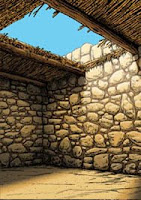
    The picture (on the right) shows the section of roof that has been removed in order that the paralyzed man might be lowered down before Jesus. The rooms in houses at this time were not very high, about 6 1/2 - 8 ft. The walls were spanned by timber beams, usually cypress or sycamore wood. These beams were spaced about the width of a man or more depending on how wealthy the home owner was and the availability of local timber. The width of the rooms was also governed by the length of roofing timbers available, usually about 9-10 ft.

    Roof construction
    I've illustrated the hole near the edge of the roof, (see above). The reason for this is that I imagined that the four friends of the paralyzed man would have wanted to do as little damage to the roof as possible. So, by digging the hole near the edge of the roof, it would be easy for them to see where the roof timbers were, as the timbers protruded through the stone walls at the end of the building. This would make it easy for them to dig between the roof timbers. Incidentally, where the roof timbers protruded, they were painted with hot tar to prevent decay.
    Reeds, sometimes bound together with natural fiber, were then laid across the timbers. A layer of mud plaster was then applied over the reeds followed by a dry mixture of chalk, earth and ash, (which provided insulation). This layer was applied while the mud plaster was still damp. Finally a mixture of mud rich in lime, (to keep out water), was added. A stone roller was used to compact each layer, very similar to the concrete rollers that gardeners use to roll lawns. The compressed layers would have been around 3 inches thick and would have required a determined effort to dig up when hard! Roofs were weeded and re-rolled on an annual basis.
    Most houses in Biblical times had flat roofs, which were used for storage and drying fruit and people also slept there in summertime.
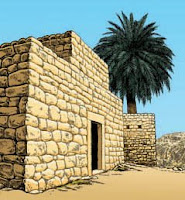
    Bible HousesWall construction
    Walls were generally around 2ft thick! This was for both insulation and strength. As you can see from the picture, roughly quarried stones were used in the walls, and 'finished' limestone blocks were used on the corners of the building, door lintels, and around the windows.
    Mortar, made from soil, chalk and straw, was then used to fill in the gaps between the stones. This was darker in color than the stone. The use of mortar helped both insulation and kept out both wind and rain! The straw that was used in the mortar was the leftover straw following the 'winnowing' of grain. Nothing went to waste!

    Windows
    I read that in first century Galilee, many windows were constructed to be narrower on the outside, to keep out intruders, and wider on the inside to let more light into the room. Apparently, this is based on an ancient Egyptian design. Windows were also small and set quite high in the wall.
    Windows were often facing a southern or easterly direction as this caught the early morning sun and acted as an early form of 'alarm clock!' Windows facing this way also gave some protection from the cold winter winds and heavy rain that generally came in from the northwest.
    Most rooms received their light from the courtyard, while the few windows in the outer walls were small - often widening out toward the inside, (see picture).
    Houses in Biblical times did not have many windows, even the rich limited the number of openings. This had several purposes. First, windows let in the cold and weather. Also, crime could be a very big problem in urban areas. Therefore outside windows were usually small and high to avoid burglary. Instead of windows, well-to-do houses got their light and air from their courtyards. The poor suffered along in the darkness or with what poor windows their insulae might have. Perhaps if they were very lucky, a shuttered balcony might also let in light and air some of the time.
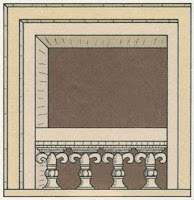


    Palaces in OT times had sometimes decorative windows. One such window was found in Ramat Rachel, where Jehoiakim had a palace. Here is my drawing of that window. Fragments of similar windows have been found in the City of David, Samaria, Hazor and Megiddo. These windows faced the courtyard and never the outside.
    Dr Leen Ritmeyer.


    Plastering
    The interior picture, (top right), is not quite accurate in that these interior walls would most probably have been plastered. You can see the smaller 'chink' stones that were set into the mortar in order to achieve a flatter surface before plastering. The plastering of interior walls was done with a mixture of soil, chalk and straw, (very similar to the mortar mix). Wealthier homes were plastered both inside and out with a white lime rich plaster. Plastered walls also kept out unwanted insects and reptiles.

    Building requirements
    Looking up through the roof you can see the compulsory 2ft high parapet wall that bordered all roofs as a safety measure. The law regarding this building requirement is found in Deut 22:8.
    If we add this 2ft high wall to the average room height of 8ft, this gives us a total height for an average single story house in Bible times of 10ft.

    Update 20 April:
    Dr Leen Ritmeyer has emailed me with some very interesting information about a possible alternative method of roof construction for the house in the Mark chapter 2 story of the paralyzed man.
    Due to a scarcity of timber, many houses were completely built of basalt, including the ceilings! For more details on this, including a diagram, go to Dr Ritmeyers blog here.

    Related posts:
    No more Domes!
    Being Roofless!

    Tuesday, April 08, 2008

    The Great Bible Discovery

    Bible Pictures
    Over the last few years, with the help of Amazon & Ebay, I've been slowly collecting 'The Great Bible Discovery' series of books, (originally published as Découvrir la Bible in 1983). There were 24 volumes in total, 18 books covering the Old Testament and 6 books covering the New. OM Publishing reprinted the whole of the New Testament as a combined book in 1999, but have no plans to reprint the Old Testament.

    This collection of books contain some very good Bible figure reference, and they've proved extremely helpful over the years. One of my favorite artists, who worked on this series of books, is 'Paolo Eleuteri-Serpieri'. He has illustrated stories in books 1, 7, 8 and 19.
    I was wondering if there was anyone out there who can help me to complete the set. There are six of the Old Testament stories that I still don't have. They are:
    10. Elijah & Elisha.
    11. Amos and the Righteousness of God.
    13. Jeremiah.
    15. Daniel, Ruth, Esther.
    17. Jonah, Job, Ecclesiastes.
    18. Pharisees Sadducees and Essenes.


    If anyone has any of the above titles for sale, please email me!
    Check out your church libraries, you might have a set gathering dust in the corner! The Old Testament books have red covers and the New Testament have blue, (see picture above).
    Many thanks for your help!
    Check out 'The Great Bible Discovery Update'

    Update: 26.11.09
    I now have the full set thanks to Stefan Koelewijn in the Netherlands!

    What do 'Ewe' think?


    It's that time of year again (in the U.K.) when all the baby lambs are born. We are very fortunate to be surrounded by farmland and we never tire of seeing the baby lambs each year.

    When I was watching the lambs this year I was reminded of something that was said by one of our church members a number of years ago. He said that he never quite understood the parable of separating the sheep from the goats, (Matt 25:31-46), until he visited the Holy land on holiday. The problem he had was that separating sheep from goats in the u.k. would be a relatively easy thing to do, whereas in the context of the parable, the suggestion is that this could be a little tricky. It was only when he actually saw the sheep in Israel, that he realized just how similar they are to the goats!

    Now, I'm not an expert on the many breeds of sheep in the u.k, but it's fair to say that the more commonly seen breeds have shorter up-turned ears and short wooly coats, as opposed to the longer lop-eared variety of sheep more commonly seen in Israel, (see photo). I also noticed that the sheep in Israel have longer, shaggier fur.
    In the interview below, Diana Shimon mentioned the importance of becoming familiar with the 'ancient fauna' of Israel.

    I have made the mistake, (a number of times), of drawing very 'English' sheep in my Bible pictures! Has anyone else made a similar mistake?
    Photo © Bibleplaces.com 2008

    Other Bible animal posts:
    Dugongs!